Ohio cosmetology CE on infection control and renewal rules
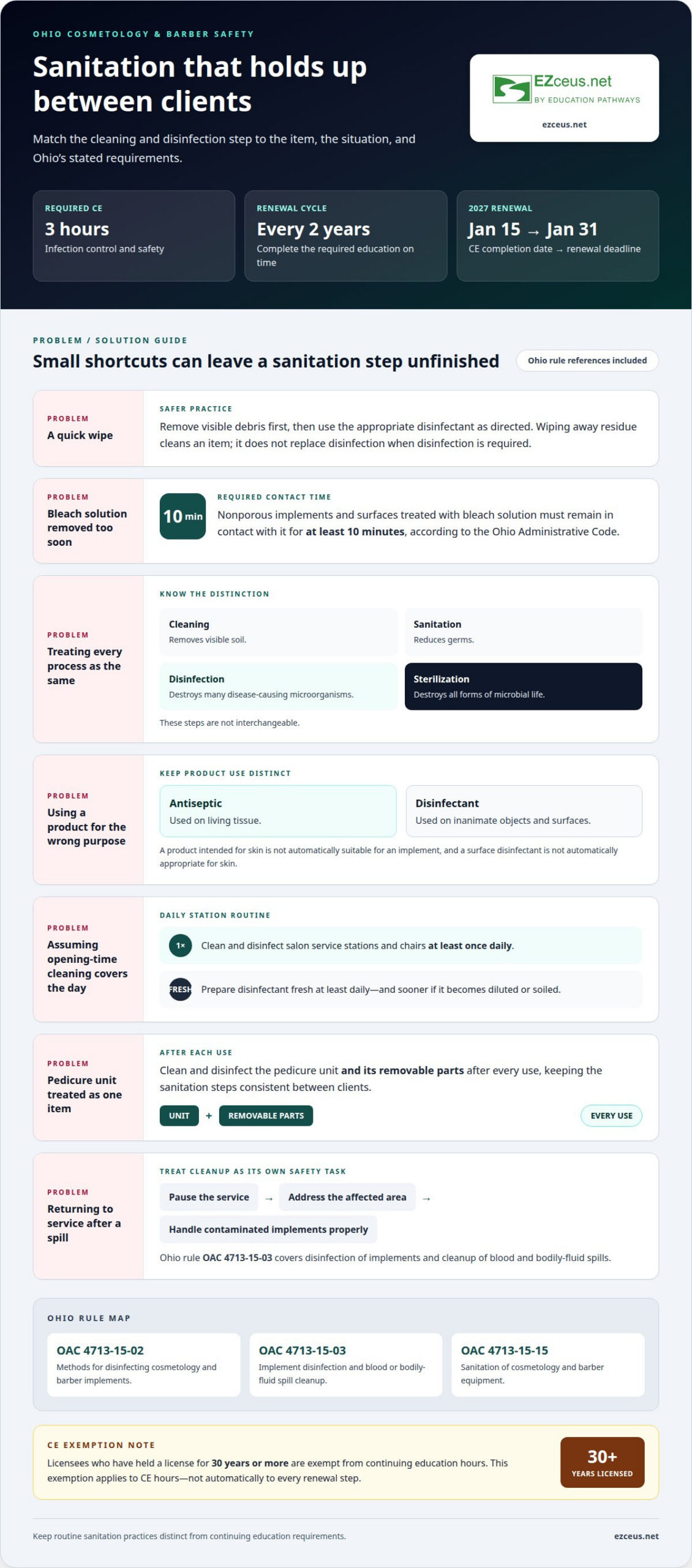
Renewal depends on completing the required education on time. Ohio cosmetology CE on infection control requires 3 hours of infection control and safety every 2 years. For the 2027 renewal, complete those hours by January 15, 2027; the renewal deadline is January 31, 2027.
It’s easy to focus on the hours and overlook how infection control connects to everyday salon work. Ohio cosmetology CE on infection control covers more than a course requirement: it supports safe handling of pathogens, disinfecting implements and surfaces, maintaining equipment, and cleaning pedicure units.
This guide explains Ohio renewal requirements and the practical sanitation rules cosmetology and barber professionals need to understand. It covers key rule references and their relevance to routine services, from cleaning blood and bodily-fluid spills to cleaning between clients. Use it to understand both the education requirement and the infection-control practices that support it.
Key Takeaways
- Ohio State Cosmetology and Barber Board rules exempt licensees who have held a license for 30 years or more from continuing education hours.
- Follow Ohio’s disinfection requirements for implements and surfaces; according to the Ohio Administrative Code, bleach solution must remain in contact with nonporous items for at least 10 minutes.
- Clean and disinfect pedicure units and their removable parts after each use to keep sanitation steps consistent between clients.
- Build infection control into every service, including hand cleansing immediately before serving each patron and proper handling of contaminated items.
Bloodborne pathogens and universal precautions
Bloodborne-pathogen awareness supports safer cosmetology and barber services when blood or bodily fluids are present. Ohio treats infection-control education and the laws-and-rules course as separate topics, so confirm which requirements apply to your license renewal.
Bloodborne Pathogen Awareness
Bloodborne pathogen awareness means recognizing that blood and certain bodily fluids can present an exposure risk during a salon service. In practice, notice when a service involves blood or a spill, pause the task, and follow the applicable cleanup and disinfection procedures. Ohio’s OAC 4713-15-03 governs disinfection of implements and cleanup of blood and bodily-fluid spills. Knowing this rule helps licensees connect safety training with the actions required in a real salon situation.
HIV and AIDS Awareness
HIV/AIDS awareness explains how these conditions relate to bloodborne-pathogen education and infection control. The course’s HIV/AIDS awareness section is 1 hour, while Ohio cosmetology licensees must complete 3 hours of infection control and safety continuing education every 2 years. Keep that distinction in mind when planning renewal: the HIV/AIDS topic is part of the broader learning, not a substitute for the full CE requirement. The Board laws and rules course is separate from infection-control education.
Blood and Bodily-Fluid Spill Cleanup
Blood and bodily-fluid spill cleanup is the prompt handling of a spill using the applicable sanitation and disinfection procedures. Stop the service, address the affected area, and handle any contaminated implements according to Ohio’s requirements. OAC 4713-15-03 covers both implement disinfection and blood or bodily-fluid spill cleanup. Treat the cleanup as a distinct safety task, rather than simply wiping the visible spill and returning immediately to the service.
For renewal planning, Ohio’s approved infection-control and safety course meets the 3-hour CE requirement for cosmetology license types. There is an exemption: according to the Ohio State Cosmetology and Barber Board, licensees who have held a license for 30 years or more are exempt from continuing education hours. This applies to CE hours, not automatically to every renewal step. Review your Ohio license status and applicable renewal requirements, including any rules course, before relying on an exemption. The October date associated with other eligibility rules is separate from this 30-year exemption.
Cleaning and disinfecting implements and surfaces
Ohio’s disinfection rules distinguish routine cleaning from procedures that reduce infection risks. Match the method to the item, and follow the product’s required contact time.
Sanitation, Disinfection, and Sterilization
Cleaning removes visible soil, sanitation reduces germs, disinfection destroys many disease-causing microorganisms, and sterilization destroys all forms of microbial life. These steps are not interchangeable. Wiping product residue from a comb cleans it, but does not replace disinfection. Choose the process required for each implement or surface, and complete the necessary steps before reuse. Sterilization is a separate concept, not another name for salon disinfection.
Implement and Surface Disinfection
Implement and surface disinfection uses an appropriate method to treat reusable tools and nonporous work areas. Ohio’s OAC 4713-15-02 covers methods for disinfecting cosmetology and barber implements. First remove visible debris, then apply the selected disinfectant as directed. According to the Ohio Administrative Code, nonporous implements and surfaces treated with bleach solution must remain in contact with it for at least 10 minutes. Keep the full contact time; a quick wipe doesn’t meet that requirement.
Ohio also requires salon service stations and chairs to be cleaned and disinfected at least once daily. Prepare disinfectant fresh at least daily, and sooner if it becomes diluted or soiled. Cleaning the station at opening does not replace disinfection after use when required.
Antiseptics and Disinfectants
An antiseptic is used on living tissue, while a disinfectant is used on inanimate objects and surfaces. Keep the distinction clear: a product intended for skin is not automatically suitable for a comb, and a surface disinfectant is not automatically appropriate for skin. Follow the product directions and Ohio’s applicable implement rules. Do not substitute one product category for another during a service.
Daily sanitation supports safe services, but it doesn’t count as continuing education or report your hours. Ohio cosmetology CE providers must submit class attendance records to CE Broker within ten days of completion. Keep the board laws course separate from control and safety education when planning each renewal period. The renewal fee is also separate from completing required education. For the education requirement, explore Ohio cosmetology and barber CE.
Equipment and pedicure-unit sanitation
Equipment sanitation means cleaning and disinfecting salon equipment under Ohio’s applicable rules. This distinction matters for pedicure units, which require attention after every use, including their removable parts.
Equipment Sanitation
Ohio’s OAC 4713-15-15 addresses sanitation of cosmetology and barber equipment. Use the rule as the reference for salon tools and equipment, rather than treating all items as interchangeable. A styling tool, work surface, and pedicure unit may require different handling under applicable sanitation rules. Identify the item first, then follow the procedure that applies to it. Cleaning visible soil alone doesn’t replace disinfection when disinfection is required.
Keep handling consistent across cosmetology and barber services. Separate used equipment from items ready for use, and do not return a used item directly to clean storage. These steps help keep handling clear between services without assuming that one method or product suits every piece of equipment.
Pedicure-Unit Sanitation
A pedicure unit is the basin or equipment used during a pedicure service. Ohio requires pedicure units and their removable parts to be cleaned and disinfected after each use. Treat the basin and detachable components as part of the same between-client sanitation task. Do not overlook a removable piece simply because it detaches or appears clean.
After a client’s service, clean and disinfect the unit and its removable parts before preparing it for another use. Follow the applicable procedures, and keep used components separate from ready-to-use items during the task. The required frequency is after each use, not merely once daily. This helps ensure a daily cleaning routine does not replace the after-use requirement.
Equipment sanitation and continuing education serve different purposes. Ohio cosmetology and barber licensees use CE for renewal requirements, while OAC 4713-15-15 concerns equipment sanitation. A course certificate or CE Broker record relates to education, not proof that a pedicure unit was cleaned after a service. Keep the work routine clear: sanitize equipment under the applicable rule, and handle renewal education separately to maintain an active license where required.
Ohio cosmetology and barber infection-control rules
Ohio’s rules connect continuing education with sanitation duties in licensed and permitted facilities. The key takeaway is to meet the course requirement that applies to your license, document completion, and keep daily procedures aligned with state rules.
Approved Providers and Courses
An approved course is one recognized for Ohio’s infection-control and safety continuing education requirement. The Ohio cosmetology Infection Control and Safety course is approved by the Ohio State Cosmetology and Barber Board and listed as meeting the 3-hour requirement for all Ohio cosmetology license types. For barbers, a separate Infection Control and Safety course is listed for barbers, barber teachers, and assistant barber teachers. Choose the course that matches your license.
License Types Requiring Infection-Control CE
License types requiring infection-control CE are the Ohio credentials subject to the applicable renewal education requirement. The 3-hour cosmetology course applies to all Ohio cosmetology license types; the barber course applies to barbers, barber teachers, and assistant barber teachers. Some exemptions apply: for example, the Ohio State Cosmetology and Barber Board says licensees with 30 years or more holding a license are exempt from continuing education hours. Confirm which category fits your license before planning renewal.
Required Infection-Control CE Topics
Required course topics are the safety subjects covered by Ohio infection-control education. The course includes a 1-hour HIV/AIDS awareness section and 2 hours of sanitation fundamentals. Related salon rules address disinfection, blood and bodily-fluid spills, equipment, shampooing items, and pedicure-unit sanitation. These subjects connect course learning with practical duties during cosmetology and barber services.
For the 2027 cosmetology renewal, complete required hours by January 15, 2027. CE providers must submit class attendance records to CE Broker within ten days after course completion. Keep your certificate and completion details with your renewal records, and allow time for reporting.
Missing the continuing education deadline can delay renewal. Ohio cosmetology licensees who miss January 15, 2027, cannot complete renewal until February 1, 2027, or later, when new courses become available. The renewal deadline is January 31, 2027, so completing hours on time matters.
EZceus: Florida Cosmetology CE Renewal
EZceus offers Ohio Cosmetology & Barber CE for Ohio licensees completing continuing education for renewal. Its online courses are self-paced, so you can fit coursework around salon or barbershop hours. After completing a course, students receive an instant digital certificate.
Choose the Ohio offering when you need continuing education for an Ohio cosmetology or barber license. Keep your completion certificate with your renewal records, and allow time for the required course hours and reporting steps before your deadline. Course education supports renewal requirements; it doesn’t replace the separate sanitation procedures you follow during services.
For other eligible states, EZceus also offers Florida Cosmetology CE Renewal, Texas Cosmetology CE Renewal, and Iowa Cosmetology CE Renewal, as well as courses for Nebraska licensees. Visit EZceus.net to explore the Ohio course and choose your next step.
Make infection control part of your routine
Turn what you’ve learned into a regular habit, not a task you revisit only at renewal. Set aside time to review your salon’s procedures, organize your continuing-education records, and note any practices that need attention. A simple routine can help keep compliance and day-to-day service standards in view as your schedule fills up.
Ohio cosmetology CE on infection control connects renewal learning with the choices you make during services. Keep building that knowledge as rules and your professional responsibilities guide your work. If you have questions about continuing education, contact EZceus with your CE questions.
Take the next step at a pace that works for you, and keep your professional learning moving forward.
Frequently Asked Questions
What are the requirements for license renewal?
Ohio cosmetology license renewal requires completing applicable continuing education, submitting the renewal application, and paying the renewal fee. For the renewal ending January 31, 2027, the education deadline is January 15, 2027. Some licensees qualify for education exemptions, including certain first-time renewals. An exemption from CE hours doesn’t remove the renewal-fee requirement, so treat education and renewal as separate steps.
What is the current CE requirement in Ohio?
Most Ohio cosmetology licensees must complete 3 hours of infection control and safety continuing education every 2 years. The Ohio cosmetology CE on infection control requirement is separate from the Board laws and rules course. Before planning coursework, identify your license type and renewal period, then account for any exemption that applies to your circumstances.
How do I complete the 3-Hour Ohio Infection and Sanitation Education Course?
Select the Ohio infection-control and safety course that matches your license, complete the coursework and assessment, and retain your completion certificate. For an online course, set aside focused study time and finish before your CE deadline. Course completion and license renewal are separate steps. EZceus reports course completion to the state board within one business day, so plan your renewal application and fee separately.
How much will it cost?
Course and renewal expenses are separate, and the total depends on the education and renewal requirements that apply to you. Identify the course that matches your Ohio credential, then account for the state renewal fee separately. This keeps planning clear and avoids confusing continuing-education expenses with the fee for renewing your license.
What are Ohio cosmetology continuing education requirements for infection control?
Ohio cosmetology CE on infection control generally consists of 3 hours of infection control and safety education per 2-year renewal period for licensees subject to CE. Course topics connect safety learning with salon practice, including pathogen awareness and sanitation. Choose an approved course for your credential, complete it by the applicable deadline, and keep your completion record for renewal documentation.
How many infection-control CE hours do Ohio cosmetologists need per renewal period?
Ohio cosmetologists generally need 3 infection-control and safety CE hours per 2-year renewal period. That is the infection-control component, not an elective-hour total. Exemptions can change what an individual licensee must complete, so consider your renewal situation and license history. For the period ending January 31, 2027, use the applicable eligibility rules and education deadline when planning.