
Chemical Safety CE for Hair Stylists: Salon Safety Reference
Chemical safety is part of the service, not a back-room detail. Chemical safety CE for hair stylists should cover product hazards, label reading, safe mixing, protective equipment, storage, and signs of overexposure. Clear routines for handling and disposing of products also help protect salon workers and clients.
It’s easy to focus on the finished color or style and overlook the steps that make chemical services safer. Knowing what a product contains, how to use it, and how to respond if something goes wrong matters at every stage of an appointment.
This guide covers practical salon safety, from staff training and product labels to storage, mixing, disposal, ventilation, and sanitation. It also explains how continuing education fits into safer routines, so you can protect clients while keeping services on track.
Key Takeaways
- Build staff training around product hazards, label reading, protective equipment, and recognizing possible overexposure.
- Use careful mixing and disposal routines to reduce spills and keep chemical handling organized.
- Keep products clearly labeled and stored properly so their contents and hazards are easy to identify.
- Pair ventilation with consistent sanitation practices to support a safer salon environment for workers and clients.
Worker training and hazard information
Salon chemical safety training turns product information into clear work practices. Start by showing staff how to identify hazards before a chemical service begins.
Chemical Safety Training
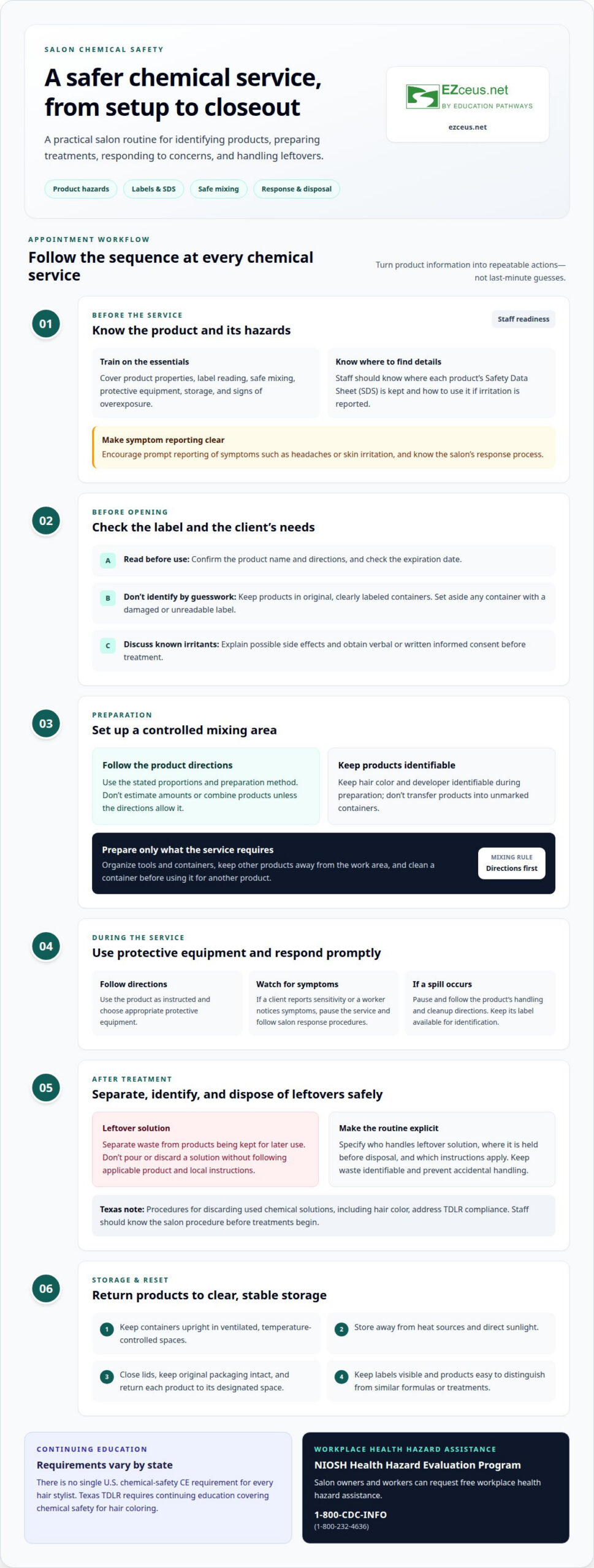
Chemical safety training helps salon workers handle products while recognizing potential hazards. Cover product properties, label reading, safe mixing, protective equipment, storage, and signs of overexposure. Staff should know where each product’s Safety Data Sheet (SDS) is kept and how to use it if a client or worker reports irritation. Establish a clear process for reporting symptoms such as headaches or skin irritation.
Continuing Education
Chemical safety continuing education updates a stylist’s knowledge of product hazards and safe service practices. There is no single U.S. chemical-safety CE requirement for every hair stylist; requirements vary by state. Texas TDLR requires continuing education covering chemical safety for hair coloring. Texas is the state identified here with that specific CE requirement.
Connect course knowledge with salon tasks. Staff can practice finding hazard and handling details in an SDS, then review product labels before mixing color or applying a straightener. They should know how to follow product directions, choose appropriate protective equipment, and recognize possible overexposure. This makes safety information useful during appointments, rather than leaving it in a course or binder.
Client communication is part of hazard awareness. Before a treatment involving a known irritant, explain possible product side effects and obtain verbal or written informed consent. If a client reports sensitivity, or a worker notices symptoms during a service, pause and follow the salon’s response procedures. Supervisors should encourage workers to report symptoms promptly, so the salon can address concerns and review the product or process involved.
Cosmetology safety data sheets provide hazard and handling information for chemicals used in salons. Salon owners and workers can request free workplace health hazard assistance from NIOSH’s Health Hazard Evaluation Program at 1-800-CDC-INFO (1-800-232-4636).
Safe mixing and disposal
Safe chemical handling means preparing treatments according to product directions and managing leftover solutions responsibly. A consistent process helps prevent mix-ups, spills, and confusion about what remains in a bowl or container.
Before mixing, identify the product and read its label. Follow the stated proportions and preparation method. Don’t estimate amounts or combine products unless their directions allow it. For example, keep hair color and its developer identifiable during preparation rather than transferring them into unmarked containers. Prepare only what the service requires, and keep other products away from the work area.
Set up a clear mixing area before opening a product. Keep tools and containers organized, and don’t use a container for another product without cleaning it. If a spill occurs, pause the service and follow the product’s handling and cleanup directions. Keep the label available so staff can identify the substance and refer to its instructions.
Disposal means removing leftover chemicals and used solutions safely after a treatment. Separate waste from products being kept for later use, and don’t pour or discard a solution without following applicable product and local instructions. Close containers after use, keep waste identifiable, and prevent clients or other staff from handling it accidentally.
In Texas, procedures for discarding used chemical solutions, including hair color, address TDLR compliance. A salon’s routine should specify who handles leftover solution, where it is held before disposal, and which instructions apply. Staff should know the procedure before treatments begin, rather than improvising at the end of a busy appointment.
Use a practical training example: prepare a color service, identify each product, follow its directions, and explain how to handle the remaining solution. For salons offering extensive lightening services, such as those highlighted in this guide to Full Head Meche Tallaght, meticulous product handling is just as vital as the final aesthetic result. Then review what staff should do if a container leaks or a product spills. This connects safe mixing with disposal and helps keep the process consistent across appointments.
Chemical labeling and storage
Clear labels help salon staff identify chemical products and understand relevant information before use. Keep products in their original containers with clear, legible labels so staff can identify them before use. A faded label or unmarked bottle makes it harder to distinguish products during a color service or straightening treatment.
Make label checks part of product setup. Read the container before opening it, confirm the product name and directions, and note the expiration date. If the label is damaged or unreadable, don’t guess what’s inside. Set the container aside so it cannot be mistaken for a product ready to use. Follow both applicable regulations and product-specific instructions.
Proper storage helps prevent damage, spills, and accidental exposure. Store containers upright in ventilated, temperature-controlled spaces, away from heat sources and direct sunlight. For example, keep a bottle away from a sunny window or hot appliance. Upright placement also helps reduce leaks and keeps labels visible on shelves.
Organize storage so products are easy to identify. Keep original packaging intact, group products so staff can distinguish them, and return each container to its designated space after use. Check that lids are closed and labels face outward. These steps help prevent confusion between similar-looking products, such as different hair color formulas or chemical treatments.
Product labels matter even when packaging claims appear clear. A California settlement announced on January 30, 2012, required specified Brazilian Blowout bottles to carry caution stickers and identify formaldehyde or methylene glycol in the ingredient list. The example shows why salon staff should read the full label instead of relying only on a product name or front-panel claim.
Include labeling and storage in routine staff training. Have workers locate a product, read its contents and hazards, check its expiration date, and return it to proper storage. Repeating these steps during everyday salon tasks keeps chemical information accessible when staff prepare services or respond to product concerns.
Safety and sanitation
Salon safety combines ventilation, protective equipment, spill response, and sanitation to reduce chemical exposure during services. OSHA’s 15-minute short-term exposure limit for formaldehyde in workplace air is 2 parts per million, according to the Occupational Safety and Health Administration.
Ventilation moves contaminated air away from workers and clients. Use general ventilation throughout the salon and local exhaust near workstations where products are mixed or applied. Windows and ceiling fans alone aren’t enough to address vapors from keratin treatments, bleach, or nail monomers. Match ventilation practices to the work, especially when heat is used.
Personal protective equipment helps limit contact with salon chemicals. Depending on the task, it can include nitrile or latex gloves, splash-proof goggles, masks rated for chemical fumes, and disposable aprons or gowns. Choose protection based on the product and task, then use it as directed. Keep clean equipment accessible before starting a treatment.
A chemical spill response is the set of actions workers follow to contain and clean a release safely. Stop the service, keep clients and other workers away from the area, and follow the product’s handling instructions. A spill kit should contain absorbent materials, gloves, goggles, and neutralizing agents. For exposure or a suspected chemical burn, follow the salon’s response procedures and first-aid guidance. Burns can result from relaxers, perms, or dyes.
Sanitation removes or controls product residue and contamination on salon tools and surfaces between clients. Disinfect work surfaces between appointments, and wash or replace towels and capes frequently to prevent chemical buildup. Keep used linens separate from clean ones, and clean areas where products were mixed or applied. These steps help prevent residue from carrying over to the next appointment.
For stylists completing renewal, Texas Cosmetology CE Renewal can support continuing education related to chemical hair services.
EZceus
EZceus provides online continuing education for cosmetologists renewing licenses. Its self-paced courses meet renewal requirements in Florida, Texas, Ohio, Iowa, and Nebraska, with instant digital certificates upon completion.
Chemical safety education can be relevant for Texas stylists who work with hair coloring products. Choose the renewal course for your state: Florida Cosmetology CE Renewal, Texas Cosmetology CE Renewal, Ohio Cosmetology & Barber CE, or Iowa Cosmetology CE Renewal. Each course supports license renewal while you continue applying safe salon practices, including careful product handling and sanitation.
If you have questions about continuing education for your renewal, contact EZceus.
Make safer routines part of every service
Make chemical safety CE for hair stylists part of a practical routine: apply what you learn consistently and build safety into service planning. This supports informed decisions at work and makes careful practice part of your professional routine.
When license renewal is your next step, choose continuing education for your state. EZceus offers Florida Cosmetology CE Renewal, Texas Cosmetology CE Renewal, Ohio Cosmetology & Barber CE, Iowa Cosmetology CE Renewal, and Nebraska Cosmetology CE Renewal. Select the applicable course to continue your renewal process, then apply your safety knowledge in everyday salon work.
If you’re ready to discuss continuing education, contact EZceus about chemical safety CE. Take the next step with a clear plan for learning and safer salon practice.
Frequently Asked Questions
How many CE hours and what topics are required for salon chemical safety?
The required hours for chemical safety CE for hair stylists depend on the state and license requirements. Continuing education requirements for chemical safety vary by state and license, so check the renewal requirements that apply to you. Training can cover recognizing product hazards, responding to exposure, and communicating treatment risks. Review the renewal requirements that apply to your state and license type.
What safety training is required for hair products containing formaldehyde or methylene glycol?
Salons using products that contain or may release formaldehyde must follow OSHA’s formaldehyde and hazard communication standards. Traditional keratin treatments may use methylene glycol or formalin, which can produce formaldehyde gas when heated with a professional flat iron. Staff need to understand the hazards of products they use and follow applicable workplace procedures. Treat product identification and heat-related vapor risks as part of service planning.
How can hair stylists find accredited chemical safety CE courses online or locally?
Choose a course that meets the renewal requirements for your state and license. EZceus provides self-paced online cosmetology CE for Florida, Texas, Ohio, Iowa, and Nebraska. Its courses are state-approved for Florida, Texas, and Ohio. For local learning, look for a course whose approval and content align with your state’s renewal rules. Confirm that the course addresses the chemical-safety topic required for your situation.
What are the health risks of salon chemicals and ways to reduce exposure?
Salon chemicals can irritate skin and affect breathing; formaldehyde levels above 0.1 parts per million in air can irritate the nose, throat, and lungs. Reduce exposure by using ventilation near chemical work, selecting protective equipment suited to the task, and following product directions. Workers should report symptoms such as headaches or skin irritation promptly. Client sensitivity and product choice also matter when planning a treatment.