What Happens If My Cosmetology License Expires in Florida?
If you’re asking, “what happens if my cosmetology license expires in Florida,” start by checking your official status with the Florida Department of Business and Professional Regulation (DBPR). An expired license may be listed as delinquent, inactive, or null and void, and each status can call for a different next step.
Don’t guess based on the expiration date or an old renewal notice. Verify your DBPR record before serving clients, and don’t practice unless your license is active.
This guide explains how to check your status and what to do if DBPR lists your license as delinquent, inactive, or null and void. You’ll also learn when continuing education (CE) may be required and why completing CE alone doesn’t renew or reinstate a license. If CE is part of your next step, EZceus offers self-paced, state-approved online Florida cosmetology courses, with an instant digital certificate upon completion. Follow the steps for your status to move forward with clarity.
Key Takeaways
- What happens if my cosmetology license expires in Florida depends on the status in your DBPR record, so check it before choosing a next step.
- Note the exact status wording, expiration date, and any notices to identify which renewal or recovery process applies.
- Distinguish an upcoming renewal from a delinquent license or a more serious lapse before taking action.
- Follow the current DBPR instructions for your specific status.
- If CE is required, self-paced, state-approved Florida cosmetology coursework can help you complete the education component.
What happens when your Florida cosmetology license expires?
If you miss your renewal deadline, your license may no longer authorize you to practice. In Florida, a license that passes its renewal deadline without being renewed becomes delinquent, and practicing with a delinquent license is illegal. The expiration date alone doesn’t tell you the status of your license. Check your Florida Department of Business and Professional Regulation (DBPR) record first.
Expiration is a renewal-status issue. It doesn’t tell you whether your record is delinquent, inactive, or null and void, or which steps you must take. The correct process depends on your record, renewal history, and the rules that apply to your situation. A recently missed renewal may follow a different process from a license left unrenewed through additional renewal periods.
So the answer to “what happens if my cosmetology license expires in Florida” isn’t always simply “renew it” or “start over.” Search your individual record through the official DBPR licensing portal. Note the exact status wording, expiration date, and any instructions or notices. Use those details to choose your next step rather than assuming that an expired license automatically cancels your qualifications or that you can continue working.
Cosmetology covers a range of professional services and specialties, as described in this general overview of Cosmetology. Florida licensing status is a separate, practical question: before performing services that require an active license, verify that your DBPR record authorizes you to practice. This is general guidance, not a legal determination about an individual license or case.
Can you work while your Florida cosmetology license is expired?
Don’t accept clients or perform regulated cosmetology services until you’ve verified that you’re authorized to practice. Florida’s rule is clear for one key status: practicing with a delinquent license is illegal. An expiration date signals that action may be needed, but your DBPR record gives you the status to act on. Check it before booking clients and follow the instructions for that status.
Does an expired license mean you must start over?
Not necessarily. Expiration alone doesn’t mean that your prior qualifications are lost or that you must repeat initial licensing steps. Your record and the circumstances of the lapse determine the appropriate route. A null-and-void status, for example, differs from a delinquent status and requires a distinct process. Check the status and current DBPR instructions before deciding what to do next.
Expiration is a signal to check your license status, not proof of its final status. Start with your DBPR record to see whether you need to renew, address a different status, or follow a reinstatement process.
How to understand your Florida DBPR license status after expiration
Your next step depends on the exact status in your license record, not just the date you remember renewing. The Florida Department of Business and Professional Regulation (DBPR) maintains the official licensing record. Visit the Florida Board of Cosmetology page to access licensing resources and search for your individual record.
Where to check your license record and expiration date
Search the DBPR portal using your license details and open the matching record. Confirm that the name and license type are yours. Record the exact status wording, expiration date, and any notices or instructions displayed. Save a dated screenshot or copy for reference. If you don’t understand a status or notice, follow the current DBPR instructions for your record rather than relying on an old email or a general description online.
This check helps answer “what happens if my cosmetology license expires in Florida” for your situation. A course certificate is a separate education record. It documents completed coursework, but it doesn’t change your DBPR status or establish that your license is active. After completing any required steps, check the license record again.
What different license-status labels may mean
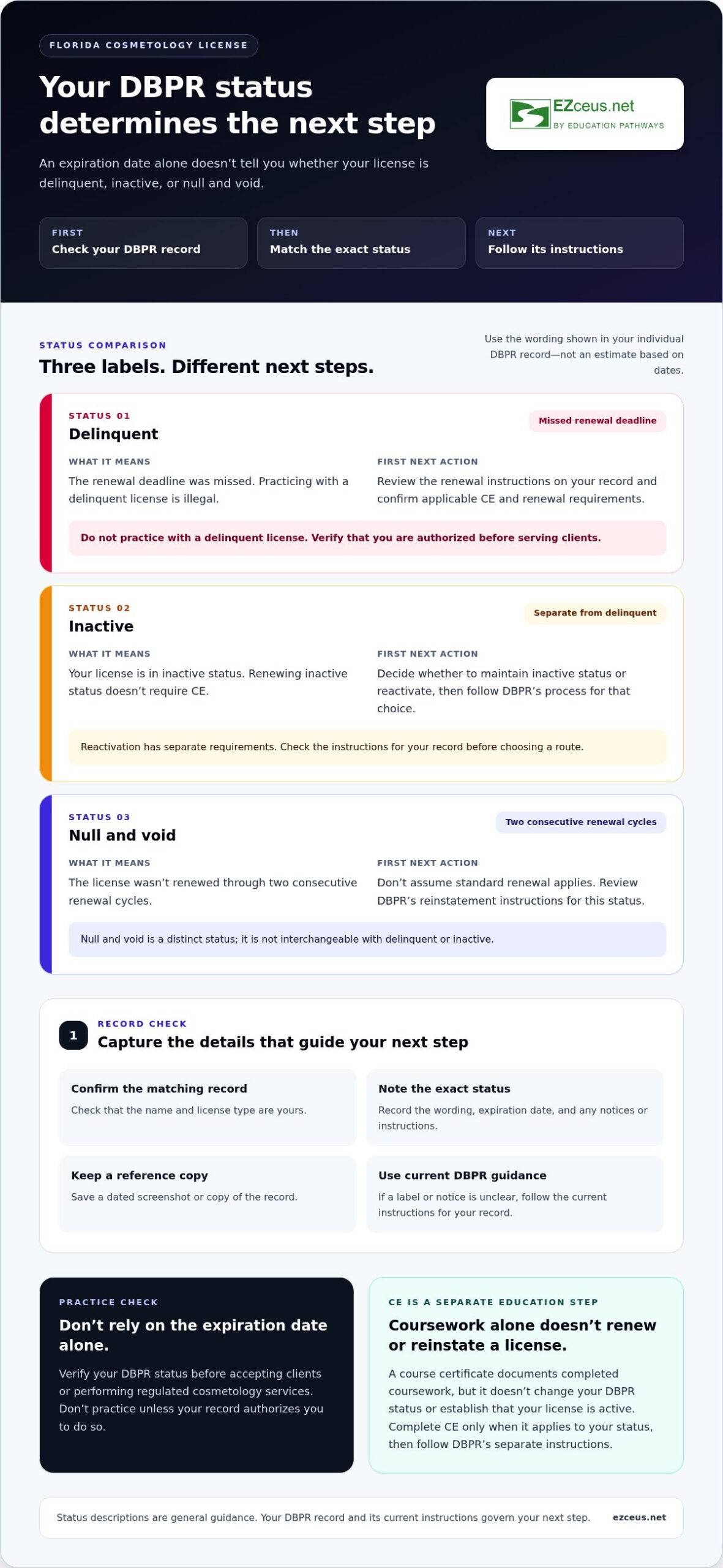
Florida’s status labels aren’t interchangeable. Use the DBPR record and its instructions as the authority for your next step, especially if the status displayed doesn’t match the general descriptions below.
| DBPR status | General meaning | First next action |
|---|---|---|
| Delinquent | The renewal deadline was missed. Practicing with a delinquent license is illegal. | Review the record’s renewal instructions and confirm applicable CE and renewal requirements. |
| Inactive | The license is in inactive status. Renewing inactive status doesn’t require CE; reactivation has separate requirements. | Decide whether you need to maintain inactive status or reactivate, then follow DBPR’s process for that choice. |
| Null and void | The license wasn’t renewed through two consecutive renewal cycles. | Don’t assume standard renewal applies. Review the DBPR reinstatement instructions for this status. |
Use the label exactly as shown. An inactive license isn’t the same as a delinquent one, and a delinquent license doesn’t automatically become null and void simply because it has expired. The change depends on renewal history and applicable rules, so verify your status through DBPR rather than estimating from dates alone.
Once you’ve confirmed that CE applies to your status, self-paced, state-approved Florida cosmetology continuing education can help you complete the education component. Keep your certificate with your records, then follow DBPR’s separate instructions to address your license status.
Expired Florida cosmetology license: compare the possible next steps
The right process depends on what DBPR shows for your license. Don’t choose a recovery route based only on how many days or months have passed. Check your official record, then compare the status and instructions with the current Florida Cosmetology License Renewal Information. The key difference is whether you’re completing a regular renewal, addressing a delinquent license, or dealing with a more serious status.
| Situation | First check | Possible next steps |
|---|---|---|
| Renewal deadline hasn’t passed | Confirm the expiration date and renewal instructions in your DBPR record. | Complete any applicable CE, then submit the renewal and payment through DBPR. |
| Deadline passed, record is delinquent | Verify that DBPR displays “delinquent” and offers a renewal option. | Follow the current renewal instructions, including any required CE and payment. |
| Record is null and void | Confirm the exact status and review DBPR’s reinstatement instructions. | A reinstatement application and additional requirements may apply; standard renewal may not be available. |
If the license recently expired
Open your individual DBPR record and check whether it’s marked delinquent and whether the portal offers renewal. A missed deadline doesn’t mean the same process applies to every license. If DBPR’s current instructions call for CE, complete the applicable coursework, then submit the renewal and payment as directed. A CE certificate documents education; it isn’t a renewal decision. Submission also doesn’t confirm that your license is active, so check the record for a status update before practicing.
If the license has been expired for longer
Length of time alone doesn’t identify the right path. Use the displayed status as your decision point. Florida’s guidance distinguishes delinquent status from null and void: a license that remains delinquent through two consecutive renewal cycles becomes null and void. That status requires reinstatement rather than simply renewing online. Current requirements include an application and a four-hour Initial HIV/AIDS course completed within the two years before applying. Follow DBPR’s instructions for the application and any other applicable requirements.
For the 2026 cycle, Group 2 licensees have until midnight Eastern time on November 2, 2026, to renew. If that deadline applies to you, check your group and DBPR record now rather than waiting for a status change. Whether you’re renewing on time or responding to a lapse, keep the steps separate: complete any required education, submit the correct DBPR renewal or reinstatement materials, make any required payment, then verify the resulting license status. Don’t treat any one of those steps as proof of active authorization until DBPR reflects it.
If DBPR confirms that CE is part of your next step, self-paced Florida cosmetology CE can help you complete the education requirement. The course addresses the education component; DBPR handles renewal or reinstatement and determines your resulting license status.
What to do now: Florida license recovery checklist
If you’re unsure what happens if my cosmetology license expires in Florida, follow your record, not assumptions. Use this checklist to organize your next steps. Your status and the current DBPR instructions determine which process applies.
- Check your official DBPR license record. Find your individual record and confirm the license type, expiration date, and exact status wording.
- Save the details. Keep a dated screenshot or copy of the record, along with any notices or instructions displayed.
- Review the process for that status. Follow the current DBPR directions for renewal, delinquent status, inactive status, or reinstatement. Don’t substitute one process for another.
- Confirm whether CE applies. Check the current requirements for your status and renewal period before enrolling in or completing coursework.
- Complete and document required education. Save your course certificate and related records. A certificate documents CE completion; it doesn’t, by itself, renew or reinstate your license.
- Submit the required DBPR action. Complete the applicable renewal or reinstatement steps, including any required application and payment, as instructed by the state.
- Check your record again. Confirm that DBPR shows active status before resuming regulated cosmetology work. Submitting materials isn’t the same as the state record confirming active authorization.
Gather the information needed before taking action
Before you begin, have your license number, expiration date, and displayed DBPR status in front of you. Note any state notices and the instructions they provide. If you’ve completed CE, record the course details and keep the certificate with your licensing documents. Then review the current official renewal or reinstatement instructions for your status. This preparation helps you follow the right process and spot any missing step.
Verify that the license is active again
After submitting the required actions, return to the public DBPR record and check the status shown. An application confirmation, payment receipt, or CE certificate doesn’t prove that your license is active. If the record still shows another status or a notice requiring action, follow the current DBPR directions before taking clients. Use the state’s current cosmetology renewal requirements as a reference for routine renewals, and rely on your individual record for your license outcome.
When CE is required for your situation, complete self-paced Florida cosmetology CE through EZceus. The courses are state-approved, and you receive an instant digital certificate upon completion. Keep the certificate, complete the separate DBPR steps, and verify your status before returning to work.
How Florida-approved online CE can help with the education step
Continuing education can address the education part of a Florida cosmetology renewal or recovery process, but only if DBPR requires it for your status. Check your license record and the current instructions before choosing a course. CE completion is separate from submitting an application, paying any required fee, and receiving confirmation that your license is active.
When an online Florida CE course may fit
If your DBPR instructions require continuing education, self-paced online study can make it easier to complete coursework around your work schedule. Florida requires 10 hours of CE for each two-year renewal period, unless an exemption applies. Required topics include sanitation and sterilization, laws and rules, HIV/AIDS, chemical makeup, environmental issues, OSHA, workers’ compensation, and an elective.
Requirements can depend on your status. For example, the current guidance states that licensees with an active license for at least 10 years and no disciplinary action are exempt from the 10-hour CE requirement. A null-and-void license has a separate reinstatement requirement, including a four-hour Initial HIV/AIDS course. Check the current DBPR instructions for your record before starting, including the required hours and course content.
Complete the CE requirement and continue the state process
EZceus offers state-approved Florida cosmetology CE as self-paced online coursework. Study online, complete the applicable course, and receive an instant digital certificate upon completion. Keep the certificate with your licensing records to document your education if needed. Don’t assume the certificate has been reported to DBPR or that your license has been renewed; follow the separate state process for your status.
Think of CE as one step in a sequence, not the finish line. First confirm whether your status calls for coursework. Then make sure the course matches the current requirements, complete it, and save the certificate. Next, submit any renewal or reinstatement materials and payment required by DBPR. Finally, check your license record for active status before returning to regulated work.
If you’re still asking what happens if my cosmetology license expires in Florida, start with your DBPR status and its current instructions. The right CE course can help you complete the education component when it applies, but the state determines your license status.
EZceus also offers online continuing education courses for cosmetologists and barbers in Florida, Texas, Ohio, Iowa, and Nebraska. Course requirements and approval vary by state.
Take the next step toward active status
Let your DBPR record guide your next move. Once you know which requirements apply, work through them in order instead of guessing. If continuing education is required, completing it takes care of the education step, while renewal or reinstatement remains a separate DBPR process.
EZceus offers officially state-approved Florida cosmetology CE through self-paced online courses. You’ll receive an instant digital certificate upon completion. Keep it with your records as you complete the steps DBPR requires, and verify your license status before returning to regulated work.
Complete your Florida cosmetology continuing education online when CE is the right next step for your status.
Frequently Asked Questions
Can I work as a cosmetologist in Florida while my license is expired?
No. If DBPR lists your license as delinquent, Florida says you may not legally practice under it. What happens if my cosmetology license expires in Florida depends on the status displayed, so check before accepting appointments or performing regulated services. A renewal submission or course certificate isn’t permission to work. Resume only after your official record confirms that your license is active.
Does a Florida cosmetology license become inactive as soon as it expires?
No. Expiration doesn’t automatically mean inactive. If you miss the renewal deadline, the license becomes delinquent; inactive is a separate status. The distinction matters because each status can involve a different process. Don’t infer that your license is inactive from an old expiration date or renewal reminder. Check your individual DBPR record and follow the current instructions for the status shown.
How long can a Florida cosmetology license remain expired before the process changes?
Florida’s status change is tied to renewal cycles, not a simple number of days after expiration. A license that remains delinquent through two consecutive renewal cycles becomes null and void. That status requires a different route from ordinary renewal. Check the expiration date and renewal history in your DBPR record, then follow the instructions for the status displayed rather than estimating from the length of the lapse alone.
Can I renew my Florida cosmetology license online after the expiration date?
Often, yes, if DBPR shows your license as delinquent and provides a renewal option for that record. Follow the portal’s current instructions, including any applicable continuing education and payment requirements. Don’t assume the same online renewal path applies to every expired license. If the status is null and void, the process is reinstatement rather than simply renewing online. Check your status before submitting anything.
Will completing continuing education reactivate my expired Florida cosmetology license?
No. Completing CE can satisfy an education requirement when it applies to your status, but it doesn’t independently renew or reactivate your license. You still need to complete the separate DBPR action required for your record and confirm the resulting status. Keep your course certificate as documentation. If DBPR requires CE, use the instructions for your renewal period or reinstatement process to determine the applicable coursework.
Do I need to retake the cosmetology exam if my Florida license expires?
Not solely because the license has expired. Under current Florida guidance, a license with null-and-void status can be considered for reinstatement without retaking the state cosmetology examination. That process has separate requirements, including an application and a four-hour Initial HIV/AIDS course completed within the two years before applying. Check DBPR’s instructions for your record, since expiration alone doesn’t determine which process applies.
Where can I check whether my Florida cosmetology license is active?
Use the Florida Department of Business and Professional Regulation’s official license search at myfloridalicense.com. Search for your individual record and confirm that the name and license type match. Check the current status and any notices, not just the expiration date. After submitting a renewal or reinstatement request, check the record again. An application receipt or CE certificate isn’t the same as an active status showing in DBPR’s system.