Online CE for Hair Stylists: 5 Myths About License Renewal Courses
What if an online course fits your salon schedule but doesn’t meet your license-renewal requirements? Online CE for hair stylists can count toward renewal, but only when the course matches your state’s rules and your license. A convenient format alone isn’t enough.
It’s easy to confuse required continuing education with classes that teach new trends or techniques. Both can support your career, but they serve different purposes. Before enrolling, check your state’s current requirements, including the topics and course type it accepts.
This guide clears up five common myths about online CE. You’ll learn how renewal courses differ from skills-focused education, what to check in a state-specific course, and how self-paced study can fit around a busy salon schedule.
EZceus offers self-paced renewal courses for cosmetologists and barbers in Florida, Texas, Ohio, Iowa, and Nebraska. Students receive an instant digital certificate after completing a course. Knowing what to look for can help you choose relevant education and keep a clear record of your learning.
Key Takeaways
- An online class doesn’t automatically count toward license renewal. Course eligibility depends on your state’s rules and your license type.
- Separate required renewal CE from optional classes focused on trends and techniques before you enroll.
- Compare course subjects and eligibility with current guidance from your state authority.
- Online CE for hair stylists can be easier to fit around salon work when the course is self-paced.
- EZceus offers state-specific courses for Florida, Texas, Ohio, Iowa, and Nebraska, with instant digital certificates to document course completion.
Online CE for Hair Stylists: Does It Mean License-Renewal Credit?
An online beauty class can be useful without counting toward license renewal. The format tells you how you take the class, not whether it satisfies a licensing requirement. Continuing education, or CE, is learning completed after initial licensure that may meet renewal rules when its content and eligibility align with the requirements for your license.
Professional learning serves different goals. A class on seasonal color trends, new products, or salon business skills can help you grow, but it isn’t automatically renewal CE. A state-specific course is designed around applicable renewal education. Before enrolling, identify your state, license type, and renewal cycle, then compare the course information with current official guidance.
Course eligibility depends on your state’s rules and license type. The word “online” alone doesn’t establish that a course qualifies.
Myth: Any online beauty class counts toward renewal
Online delivery is a format, not an approval category. A class may offer relevant information and still not meet a particular state’s requirements. The licensing authority’s rules determine which topics, course types, or approvals apply to a license. A course accepted for one license or state may not be eligible for another.
Consider two examples. A virtual class on a trending balayage technique may offer useful inspiration for client work, but it may be optional skills education rather than renewal credit. A state-specific CE course, by contrast, is designed for applicable renewal requirements. Both can have value. Treat a course as renewal education only when it meets the rules for your license.
Separate the two goals before you register: Are you learning a technique for the salon, or completing required education for renewal? If you need credit, look beyond the online format and course title. Check that the course is intended for your license type and addresses eligible subject areas. A certificate can document completion, but it doesn’t by itself prove that a state will accept the course.
Myth: Online CE is only for beginners
CE serves licensed professionals, not just people starting out. After initial training and licensure, a stylist may use continuing education to meet renewal needs and complete required learning. The subject may relate to professional responsibilities rather than introduce a new haircut, color method, or salon service.
That’s different from initial cosmetology or hairstyling training, which prepares someone to pursue licensure. Renewal CE doesn’t replace that foundational education, and completing a CE course doesn’t automatically grant a new credential. Its purpose depends on the course and the applicable rules.
Cosmetology covers hairstyling alongside related beauty practices, as outlined in this general overview of Cosmetology. Broad professional learning and required renewal education aren’t interchangeable. Choose based on your immediate goal: build a specific skill or complete eligible CE for your license. That distinction helps you spend your learning time where it counts.
What Online Hair Stylist CE Can, and Cannot, Do
Online CE can help licensed professionals complete renewal education in a format that fits around salon work. But “online” describes how a course is delivered, not what it qualifies for. A self-paced class may be convenient and relevant while still needing to match your state’s rules, license type, and required subject areas before you count it toward renewal.
Separate two learning goals. Renewal-focused education addresses requirements that apply to your license. Skill-building classes focus on optional professional development. Both can be worthwhile, but they don’t automatically serve the same purpose. For an overview of how requirements vary by location, see Hairstylist Licensing Requirements by State, then use current guidance from your licensing authority to confirm what applies to you.
Renewal education versus skill-building classes
Renewal CE may cover subjects such as sanitation, laws, or rules when those topics are part of applicable state requirements. While learning new cutting techniques or adopting salon-grade smoothing lines from Hair Bar NYC Professional can help you serve clients and expand your services, it isn’t automatically eligible renewal education. Check the course’s stated purpose and content against the requirement you need to meet. One builds optional skills; the other supports a licensing obligation.
Self-paced study offers flexibility, not universal eligibility. You can work through course material on your own schedule, but the learning format doesn’t make a course suitable for every state or license. Online CE for hair stylists is most useful for renewal when the course is designed for the relevant requirement and applies to your license.
Before starting, compare the course details with your renewal needs. Review the intended license type, eligible subject areas, and state-specific approval information. Requirements differ, so don’t rely on a course title or a general claim that it is “for stylists.” Match the details to your license.
What a digital certificate proves
A digital certificate documents that you completed a course. Keep it with your renewal records so you can readily refer to the completion details. It’s useful evidence of your learning, but it doesn’t by itself establish that a licensing authority has accepted the course or renewed your license. Follow the state’s process for recording or reporting CE and retain any documentation it requires.
A course completion certificate records learning; only the licensing authority’s renewal process determines whether your professional license is renewed. That distinction keeps expectations clear. If you’re looking for flexible, state-specific study, explore self-paced online CE courses and choose the pathway that aligns with your license and renewal needs.
How State Rules Change Online CE for Hair Stylists
There’s no single renewal checklist for every stylist. States can set different requirements for course content, delivery, and license eligibility. A course that fits one jurisdiction may not meet another’s rules, even if both licenses involve cosmetology. Match the course to your credential and renewal state, then verify the details with that state’s official licensing authority.
Use the table below as a starting point, then compare the listed course-eligibility considerations with current guidance from your state authority. Requirements can change, so use the authority’s latest renewal materials when planning your CE.
| State | Relevant authority | Course-eligibility check |
|---|---|---|
| Florida | Florida Department of Business and Professional Regulation (DBPR), including the Board of Cosmetology | Compare the course and your license type with current DBPR renewal and CE guidance. |
| Texas | Texas Department of Licensing and Regulation (TDLR) | Check current TDLR requirements, including required subject areas such as sanitation and human trafficking awareness. |
| Ohio | Ohio State Cosmetology and Barber Board | Confirm course eligibility and required topics, including applicable laws, rules, safety, and infection control. |
| Iowa | Iowa licensing authority for cosmetology arts and sciences | Check the current authority’s requirements for your discipline and applicable laws, rules, and infection-control subjects. |
| Nebraska | Nebraska Department of Health and Human Services (DHHS), for cosmetology-related licensing | Verify eligible online coursework and whether any required hands-on learning must be completed separately. |
Why the same course may not suit every license
A state may specify subjects, course formats, or other conditions that don’t apply elsewhere. License type matters, too. A cosmetologist and a barber may follow different requirements, even in the same state. Don’t assume that a course accepted for a colleague or a neighboring state will work for you. Start with your exact credential and renewal jurisdiction, then compare those details with the course information.
EZceus offers state-specific renewal courses for cosmetologists and barbers in Florida, Texas, Ohio, Iowa, and Nebraska. Courses for Florida, Ohio, and Texas are officially state-approved. For a broader overview of state-specific CE considerations, use this 2026 hair professional continuing education guide. Florida licensees can also find renewal details in the Florida cosmetology license renewal guide.
Where to find state-specific renewal guidance
Use the official licensing authority’s current renewal materials as your final reference. Florida stylists can consult DBPR, and Texas stylists can consult TDLR. For Ohio, Iowa, and Nebraska, locate the current state agency or board responsible for your license and confirm its latest CE guidance. This helps you match your online CE to the rules for your license rather than relying on a general or outdated summary.
A Simple Checklist for Choosing Online CE as a Hair Stylist
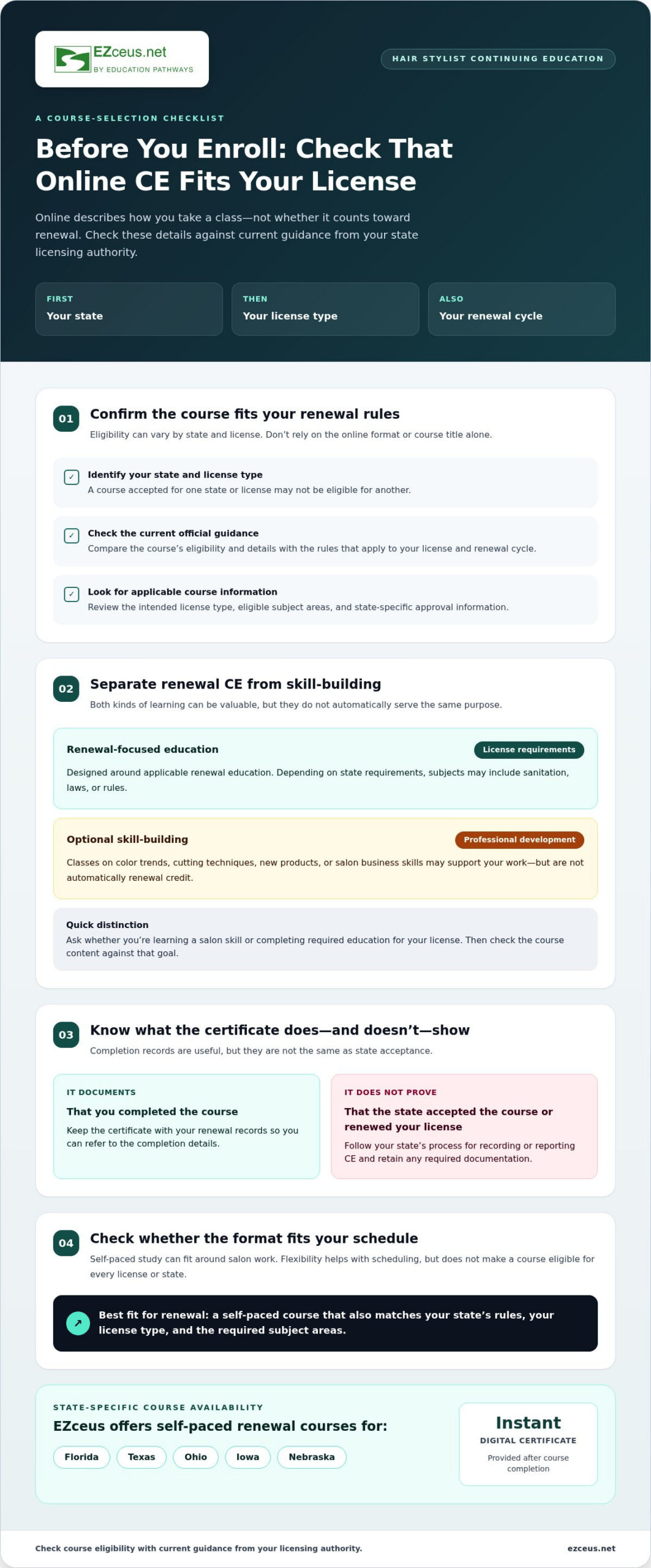
A short check before enrolling can prevent a course mismatch and help you keep renewal records organized. Start with your own license details, not a generic course description. Then compare the course with current official guidance and make a realistic plan to finish around salon work.
Check the course against your license
Eligibility begins with the jurisdiction and credential attached to your license. The same course may not suit every state or professional license. Use the state authority’s current renewal instructions as your reference, especially if you hold more than one license.
- Identify your state, license type, and renewal cycle. Note where your license was issued, the exact credential you hold, and when it must be renewed. If you have licenses in multiple states, assess each one separately.
- Find current official renewal guidance. Use the relevant state licensing authority’s website or renewal materials. Confirm the current requirements rather than relying on an old course page, a colleague’s experience, or a rule that applies to another state.
- Check course eligibility. Review the course’s stated audience and whether it applies to your particular license. Look for clear state-specific information, including approval details where applicable. A broad label such as “beauty education” doesn’t tell you whether a course meets your renewal requirement.
- Compare required subjects and credits. Match the course content and credit information with current state instructions. Some requirements specify subject areas. Check that the course covers the parts relevant to your license instead of assuming any cosmetology topic will qualify.
- Plan when you’ll study. Choose a study window that works with your salon schedule and leaves room to complete the course before your renewal deadline. Self-paced learning offers flexibility, but setting aside time helps keep the requirement from becoming a last-minute task.
- Save completion documentation and follow the renewal process. Keep your digital certificate and relevant course details with your records. Then follow your state’s current instructions for renewal and any required documentation. A certificate documents completion; don’t assume it replaces a renewal application or state reporting steps.
Plan completion and keep a record
Make recordkeeping part of the process. After finishing, save the certificate somewhere you can find it, along with useful details such as the course name and completion date. Keep these records organized through the renewal cycle. If the state provides instructions for submitting or retaining CE documentation, follow them directly.
This checklist makes online CE for hair stylists easier to approach: verify first, schedule your learning, and keep proof of completion. For a state-specific path, explore online CE courses for cosmetologists and barbers in Florida, Texas, Ohio, Iowa, and Nebraska.
How EZceus Makes State-Specific Online CE More Manageable
License renewal is easier to organize when the course pathway is built around your state and professional license. EZceus provides self-paced online continuing education for cosmetologists and barbers in Florida, Texas, Ohio, Iowa, and Nebraska. Study at a pace that works with your schedule instead of adding a fixed class time to a packed salon calendar.
Self-paced study is a format, not a substitute for checking requirements. Before starting, match the course to your state, license type, and current renewal guidance. That step helps you focus on relevant education rather than assuming one online course fits every license. If you’re comparing options for online CE for hair stylists, state-specific course information can make the path clearer.
A self-paced format for working salon professionals
Client appointments, salon responsibilities, and changing workdays can make it difficult to set aside a fixed block for education. A self-paced format lets you plan study around those demands. You still need to choose a course that aligns with your license and renewal rules, then make a realistic plan to complete it before renewal is due.
EZceus offers renewal education for five states: Florida, Texas, Ohio, Iowa, and Nebraska. This state-focused approach helps learners find a relevant course pathway instead of sorting through general professional development classes. The course should still be compared with current state guidance, since the licensing authority sets renewal requirements and eligible subject areas.
State-focused courses and completion certificates
EZceus courses for Florida, Ohio, and Texas are officially state-approved. Courses for Iowa and Nebraska meet renewal requirements as well. Review the applicable course and state guidance for your specific license before enrolling. The goal is a clear match between your credential, the course, and the renewal education you need.
After completing a course, students receive an instant digital certificate. Keep it with your renewal records as documentation of course completion. A certificate is a useful record, but it doesn’t by itself mean the state board has received or accepted credits, or that your license has been renewed. Follow the current state process for reporting or documenting CE and completing renewal.
Self-paced learning, state-specific pathways, and completion documentation can make continuing education more manageable without blurring the difference between finishing a course and renewing a license. For a broader look at course and renewal considerations, explore the 2026 hair professional continuing education guide.
Make Your Next Renewal Step Count
Turn your renewal date into a practical plan. Set a reminder, identify the course subjects you need, and choose a study window that fits your salon schedule. A little preparation can make continuing education feel less like a last-minute scramble and more like one manageable task at a time.
EZceus offers self-paced online continuing education for cosmetologists and barbers in Florida, Texas, Ohio, Iowa, and Nebraska. Florida, Ohio, and Texas courses are officially state-approved. Students receive instant digital certificates after completing a course, providing a record of completion. Follow your state’s renewal process and keep any required documentation; a certificate alone doesn’t confirm license renewal.
Choose online CE for hair stylists with your license and current state requirements in mind. Then take the next step: Explore self-paced online CE for hair professionals. Find relevant learning, keep a clear completion record, and make a plan that works around your professional commitments.
Frequently Asked Questions
Can I complete online CE for hair stylists in more than one sitting?
Self-paced courses let you work through the material on your own schedule. Breaking study into shorter sessions can help you fit learning around appointments and other salon responsibilities. Review the course instructions for how to access the material and track your progress. Set a reminder to finish with enough time to follow your state’s renewal process.
Does completing an online CE course renew my cosmetology license automatically?
No. Completing a course is not the same as renewing a license. You may still need to submit a renewal application, meet other state requirements, and provide documentation through the process your licensing authority specifies. After finishing CE, check your state’s renewal portal or official instructions for the remaining steps. Keep your certificate and any submission confirmation together so you can refer to them if questions arise.
Can a hairstylist use barber CE courses for license renewal?
Only if the course is eligible for the specific license you hold under your state’s rules. Similar professions don’t automatically share renewal requirements. For example, a cosmetology license and a barber license may have different course eligibility, even if both professionals work in a salon. Check the course’s intended license type and compare it with your state authority’s current guidance before relying on it for renewal credit.
Do online CE courses always require a live class or instructor?
No. Online courses may be self-paced, with lessons completed independently, or may include scheduled instruction. The format depends on the course and any applicable state rules. Before enrolling, check whether the course requires live attendance, interaction, or a specific way to complete the material. If your schedule changes often, an eligible self-paced course may be easier to plan around than a class at a fixed time.
What should I do if my state is not listed among the course options?
Don’t assume a course designed for another state will count toward your renewal. Start with your licensing authority’s current CE instructions and look for a course explicitly applicable to your state and license type. This matters for stylists in Florida, Texas, Ohio, Iowa, Nebraska, and elsewhere because renewal rules are jurisdiction-specific. Confirm the eligible subjects and any format limits before enrolling in a course.
How can I tell whether a CE certificate is proof of state approval?
A certificate documents that you completed a course; it doesn’t by itself prove state approval. Look for course or provider approval details, then compare them with the licensing authority’s official CE listings or guidance. Check that the approval applies to your state, license type, and course. Keep the certificate as completion documentation, and follow your state’s instructions for reporting or submitting CE during renewal.