
Florida Cosmetology Laws and Rules Course: A Complete Guide to Compliance
Could a single overlooked update to Florida’s statutes put your entire cosmetology career on hold? It’s a stressful thought for any busy professional. You’ve worked hard to build your reputation, and navigating the fine print of license renewal shouldn’t feel like a second job. Most stylists and specialists dread the legal part of their continuing education because it’s often buried in complex jargon and outdated manuals. You need a fast, reliable way to complete your Florida cosmetology laws and rules course without the confusion.
We understand that your time is your most valuable asset. You’re looking for a straightforward path to compliance that doesn’t involve hours of unnecessary study. This guide is designed to simplify the mandatory 2-hour legal requirement. We’ll explain the latest DBPR changes, including the 2024 exemptions for long-tenured professionals, and show you how EZceus ensures your certificate is reported promptly for seamless compliance. You’ll move from renewal anxiety to total peace of mind in one sitting. By the time you finish reading, you’ll have a clear, step-by-step roadmap to keep your license active and your career protected.
Key Takeaways
- Identify the mandatory 2-hour legal requirement that anchors your 10-hour Florida license renewal package.
- Gain clarity on salon inspection protocols and official license display rules to avoid costly compliance errors.
- Decode the practical differences between state statutes and administrative codes within your Florida cosmetology laws and rules course.
- Follow a simple, step-by-step process to complete your training and receive an instant certificate for DBPR verification.
- Transition from renewal anxiety to total peace of mind with a self-paced, mobile-friendly solution designed for busy pros.
What is the Florida Cosmetology Laws and Rules Course?
The Florida cosmetology laws and rules course is a mandatory 2-hour education block. It isn’t just a suggestion; it’s a legal requirement from the Florida Department of Business and Professional Regulation (DBPR). This course focuses on the legal framework that keeps your license valid in the Sunshine State. It covers the specific rules that govern Cosmetology practices, ensuring you’re up to date on administrative changes and public safety standards. Think of it as your professional insurance policy. By understanding these laws, you protect your career from fines or suspensions.
The 10-Hour Renewal Context
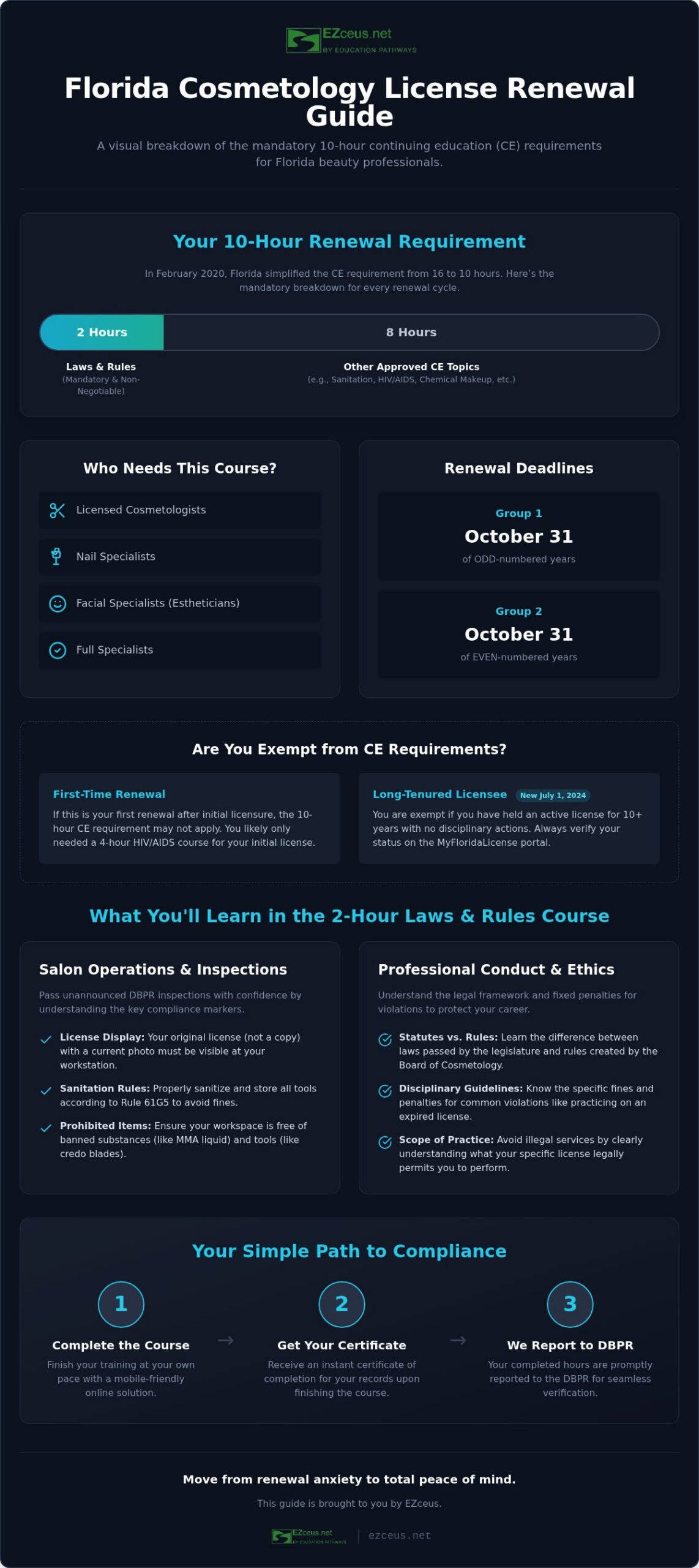
In February 2020, Florida reduced the total continuing education (CE) requirement from 16 hours down to 10. While this made renewal easier, it also made the specific components more rigid. The 2-hour laws and rules module is a fixed piece of that 10-hour puzzle. You can’t swap it for an extra hour of hair styling or nail art. It’s a non-negotiable legal requirement. If your renewal package is missing these two specific hours, the DBPR won’t recognize your completion. For a complete breakdown of every required subject in your renewal, see our Florida cosmetology 10 hour continuing education package guide.
Timing matters. Florida splits licenses into two groups to manage the volume of renewals. Group 1 licenses expire on October 31st of odd-numbered years. Group 2 licenses expire on October 31st of even-numbered years. You must finish your Florida cosmetology laws and rules course and the rest of your 10 hours before your specific deadline. Missing this window leads to a “delinquent” license status and extra fees. Keeping track of your group ensures you aren’t scrambling at the last minute.
Who Must Take This Course?
Most professionals working in the beauty industry need this course. If you hold a license issued by the Board of Cosmetology, this requirement applies to you. This includes:
- Licensed Cosmetologists: Professionals providing a full range of hair, skin, and nail services.
- Nail Specialists: Registered professionals focusing on manicures and pedicures.
- Facial Specialists: Estheticians providing skin care and hair removal services.
- Full Specialists: Those registered to perform both nail and facial services.
There are a few nuances to keep in mind. If you’re renewing for the first time after receiving your initial license, your requirements might differ. Usually, first-time applicants complete a 4-hour HIV/AIDS course for their initial license and don’t need the full 10-hour CE until their first biennial renewal. Additionally, as of July 1, 2024, if you’ve held an active license for at least 10 years without any disciplinary action, you’re exempt from CE requirements entirely. You should check your status on the My Florida License portal to confirm if you still need to complete these hours.
Core Curriculum: What You Will Learn
A Florida cosmetology laws and rules course isn’t just about memorizing numbers. It’s about understanding the “Rules of the Road” for your career. The Florida Board of Cosmetology, which consists of seven members appointed by the Governor, has the legal authority to set safety standards and issue discipline. This section of your education ensures you know exactly who has oversight of your license and how they exercise that power. You’ll move beyond basic sanitation tips and dive into the legal consequences of failing to meet state standards.
Salon Operations and Inspections
Inspectors from the DBPR can walk into your salon at any time. They don’t need an appointment, and they don’t give warnings. During these visits, they look for specific compliance markers that many professionals overlook. For instance, every practitioner’s license must be displayed at their workstation with a current, recognizable photograph. If you’ve recently changed your salon’s ownership or moved locations, you have strict deadlines to notify the state and update your salon license. Failing to do so can result in immediate citations.
For booth renters and independent contractors, the rules are equally strict. You’re responsible for your immediate workspace. This includes:
- Displaying your original license (not a photocopy).
- Keeping your work area free of prohibited items like MMA or credo blades.
- Ensuring all tools are properly sanitized and stored according to Rule 61G5.
Understanding these specifics helps you breeze through inspections without the stress of potential fines.
Professional Conduct and Ethics
The state uses a specific set of disciplinary guidelines to handle violations. These aren’t suggestions; they’re fixed penalties. For example, practicing on an expired license or performing services outside your scope of practice can lead to fines ranging from $250 to $500 for a first offense. Repeated violations can lead to license suspension or permanent revocation. The DBPR also investigates consumer complaints, ranging from poor sanitation to unlicensed activity. Knowing how to handle these situations ethically protects your reputation and your livelihood.
Managing your administrative profile is just as important as your technical skills. If you move or change your legal name, you must update your record with the DBPR within 30 days. This ensures you receive critical renewal reminders and legal notices. If you want to handle these requirements quickly and get back to your clients, you can start your Florida cosmetology CE renewal with our mobile-friendly modules today.
Statutes vs. Rules: Decoding the Legal Source
Stylists often get confused by legal terminology. You’ll hear about statutes and rules interchangeably, but they serve different functions in your daily work. A Florida cosmetology laws and rules course helps you tell them apart. Knowing the source of a regulation helps you understand if it’s a broad legal requirement or a specific operational instruction. This clarity ensures you don’t waste time on irrelevant details while staying fully compliant with state mandates.
Chapter 477: The Foundation
Chapter 477 is the primary legislative authority for Florida stylists, setting the legal boundaries for the entire profession. This document, officially known as the Florida Statutes Chapter 477, represents the high-level law passed by the state legislature. In plain English, it’s the “Law of the Land.” It defines what a cosmetologist is and what they are legally allowed to do. The legislative intent is simple: to protect the public from unskilled or unsanitary practices. If the statute says you need a license to perform a service, that is the final word. It creates the skeleton that the Board of Cosmetology must follow when making smaller, day-to-day decisions.
Rule 61G5: The Practical Application
If Chapter 477 is the “what,” then Rule 61G5 is the “how.” The Florida Board of Cosmetology uses the Florida Administrative Code, specifically Rule 61G5, to explain how the law works in a salon environment. Think of it as the instruction manual for the statute. While the law says you must be sanitary, the rule tells you exactly how to clean a footbath or which chemicals are prohibited. These rules are developed during public board meetings where industry professionals can provide feedback. This process allows the board to react to new beauty trends faster than the legislature can pass a new bill. Your Florida cosmetology laws and rules course will dive deep into these specifics so you know exactly which sanitation protocols are current.
Legislative changes keep the industry moving and often reduce your administrative burden. A major shift happened in 2020 when the total CE requirement dropped from 16 to 10 hours. More recently, the July 1, 2024 update introduced an exemption for professionals with 10 years of clean practice history. These updates aren’t just red tape; they represent a move toward deregulation for experienced pros while keeping safety standards high. Understanding these sources ensures you’re never caught off guard by a new rule change or a surprise inspection. You stay in control of your career by knowing where the laws come from and how they apply to your chair.
How to Complete the Course and Report Your Credits
Completing your Florida cosmetology laws and rules course is the final hurdle before you can safely renew. The process is straightforward if you follow the right steps. First, ensure your chosen provider is officially DBPR-approved. Without this approval, the state won’t recognize your hours, and you’ll have wasted both time and money. Once you’ve selected a partner like EZceus, you can move through the 2-hour module at your own pace. Most modern platforms allow you to stop and start as needed. This is perfect for fitting education between your client appointments. After finishing the material, you’ll likely complete a short assessment to confirm you’ve grasped the legal essentials. If you want to satisfy all your renewal subjects at once, our florida cosmetology 10 hour continuing education package bundles every required topic into one convenient, state-approved course.
The Role of CE Broker
Florida uses CE Broker as the official system of record for all continuing education credits. Think of it as a digital transcript for your license. When you finish a course, a reputable provider will automatically report your hours to this system. You don’t need to mail anything to the board. You can create a free “Basic” account on CE Broker to monitor your compliance status in real-time. If you see a “Complete” status next to your license, you’re ready to pay your renewal fee on the DBPR website. If credits are missing after 24 hours, check your profile. Common reporting delays often stem from a simple typo in your license number or a name mismatch between your certificate and your state record.
Obtaining and Storing Your Certificate
Even with automated reporting, you need to keep your own records. Always download your instant digital certificate immediately upon completion. The Florida Board of Cosmetology can audit professionals at any time. You’re legally required to keep your CE documentation for at least two renewal cycles. That equals four years of records you must maintain. While the state accepts digital copies, having a backup ensures you’re protected during an inspection or technical glitch. Storing a PDF on your phone or in a cloud folder is the most efficient way to stay organized. This habit prevents the last-minute panic of trying to prove you’ve met the requirements.
- Double-check your license number for typos during registration.
- Finish the full 2-hour laws and rules module.
- Download your digital certificate for your permanent records.
- Verify the “Complete” status on CE Broker before paying the DBPR fee.
Ready to get started? You can complete your Florida cosmetology CE renewal now and receive your certificate instantly.
Finish Your Florida Renewal Fast with EZceus
Your renewal deadline shouldn’t be a source of stress. You need a direct path to compliance that respects your schedule. EZceus provides exactly that. Our Florida cosmetology laws and rules course is designed for the modern professional. It’s state-approved and meets the mandatory 2-hour requirement perfectly. You don’t have to worry about complex bureaucratic hurdles. We’ve simplified the legal jargon into a no-nonsense format. You get the information you need and nothing you don’t. This efficiency allows you to focus on your clients while we handle the regulatory details.
Choosing a provider with a long track record matters. We’ve been a dependable partner for Florida professionals since 2002. Over two decades of experience means we understand every shift in DBPR regulations. We don’t just offer courses; we offer peace of mind. Our platform is built for speed and reliability. You won’t find dense, multi-clause explanations here. Instead, you’ll find clear, declarative statements that get straight to the point. It’s a professional resource that feels like a helpful guide.
Why Stylists Choose EZceus
Efficiency is our core value. Our platform is fully mobile-friendly. You can finish your modules on your phone between clients or during a quick break. It’s entirely self-paced. There’s no pressure to finish in one sitting. This flexibility is essential for a busy salon environment. We also understand the diversity of Florida’s beauty industry. That’s why we offer our curriculum in Spanish through our Peluquería courses. It’s about making compliance accessible to everyone without unnecessary difficulty.
The benefits are immediate. The moment you finish the Florida cosmetology laws and rules course, your digital certificate is ready for download. There’s no waiting for an email or a packet in the mail. Even better, we include automated reporting to CE Broker with every course. We push your credits to the state system so you can see your compliance status update in real-time. It’s a feature-then-benefit logic that works. You complete the course, and we handle the paperwork. This transparency builds trust and reduces the anxiety of missing a deadline.
Ready to Renew?
The path to license renewal is clear. You can sign up for the full 10-hour package or target the specific 2-hour law course if that’s all you need. The process is transparent and honest. There are no hidden steps or confusing menus. You’re just a few clicks away from a valid license and a stress-free renewal season. We’ve navigated the complexities of the law so you don’t have to. You can trust our experience to get you across the finish line quickly.
Get your Florida Cosmetology Laws and Rules course now
Secure Your License and Peace of Mind
Maintaining your professional standing in Florida doesn’t have to be a headache. You now have the roadmap to navigate the mandatory 2-hour legal requirement with confidence. By understanding the distinction between Chapter 477 and Rule 61G5, you’ve already simplified the most complex part of your renewal. Compliance is about more than just checking a box; it’s about protecting the career you’ve built.
Choosing the right Florida cosmetology laws and rules course means you can stop worrying about deadlines and start focusing on your clients. Our platform provides a DBPR-approved curriculum that respects your time. You’ll receive an instant digital certificate the moment you finish, and we’ll handle the automated reporting to CE Broker for you. There’s no paperwork to mail and no waiting for verification.
Start Your Florida Laws and Rules Course Today and get back to doing what you love. You’ve worked hard for your license, and we’re here to make the process as smooth as possible.
Frequently Asked Questions
Is the Florida cosmetology laws and rules course mandatory for every renewal?
Yes, the Florida cosmetology laws and rules course is a mandatory 2-hour requirement for most license renewals. Every two years, professionals must complete this specific block to keep their license active. However, as of July 1, 2024, you may be exempt if you have held an active license for 10 consecutive years with no disciplinary action. Always check your status on the My Florida License portal before starting your hours.
How many hours is the Florida laws and rules course?
The laws and rules component consists of exactly 2 hours of study. These hours are part of the total 10-hour continuing education package required by the state. While other hours cover sanitation or chemical makeup, these two hours focus specifically on state statutes and administrative codes. You cannot substitute these hours with elective topics. Completing this block ensures you understand the current legal standards governing your salon work.
Can I take the Florida cosmetology law course online?
Yes, you can complete your Florida cosmetology laws and rules course through a state-approved online provider. EZceus offers a self-paced platform that works on any mobile device or computer. This is the most efficient way for busy stylists to fulfill their requirements without attending in-person workshops. After you finish the module, your certificate is generated instantly. We then report your hours directly to the state tracking system for you.
What happens if I don’t complete the laws and rules course by my deadline?
Your license will become delinquent if you miss the October 31st deadline without finishing your CE hours. You’ll be required to pay the standard renewal fee plus a late fee, which is typically $25. Practicing with a delinquent license is a violation of state law and can lead to administrative fines. If your license remains delinquent through a second renewal cycle, it will become null and void, requiring a full reapplication.
Do I need to report my course completion to the DBPR myself?
No, you don’t need to report your hours manually if you use an approved provider. EZceus includes automated reporting to CE Broker, which is the official database used by the DBPR to verify compliance. We submit your completion data within 24 hours of you finishing the course. You can log into your free CE Broker account to see your status update to “Complete” before you pay your biennial renewal fee.
Does this course cover the mandatory HIV/AIDS requirement too?
The 2-hour laws and rules module is a separate requirement from the 1-hour HIV/AIDS course. Both are mandatory parts of the 10-hour Florida renewal package. While the laws course covers legal statutes, the HIV/AIDS hour focuses on communicable diseases and workplace safety. Most professionals choose a full 10-hour renewal package to cover all subjects at once. This ensures no mandatory topics are missed during the renewal process.
How long is my Florida cosmetology license renewal certificate valid?
Your course completion certificate is valid for the current two-year renewal cycle. Florida uses a biennial system where licenses expire every two years on October 31st. You must finish your education within that specific window. It’s a good professional habit to keep your digital certificates for at least two renewal cycles, or four years. This documentation is your proof of compliance if the state board ever conducts a random audit.
What is Chapter 477 in the Florida Statutes?
Chapter 477 is officially known as the Florida Cosmetology Act. It is the primary state law that regulates the beauty industry and establishes the Board of Cosmetology. This statute defines the legal scope of practice for cosmetologists, nail specialists, and estheticians. It sets the high-level standards for safety and licensure. While administrative rules provide the specific “how-to” instructions for salons, Chapter 477 provides the legal foundation for the entire profession.