Online Sanitation Course for Cosmetologists
What if the sanitation course that fits your schedule doesn’t count toward license renewal? An online sanitation course for cosmetologists can reinforce the infection-prevention habits you use every day, but state and license requirements determine whether the learning applies to continuing education.
It can be hard to sort out which practices matter most, which subjects your state requires, and how to fit coursework around a full salon schedule. A useful course should make those decisions clearer. For example, most Texas cosmetologists need four hours of continuing education every two years, including sanitation and human trafficking prevention. Requirements differ elsewhere, so review your licensing authority’s current rules before enrolling.
This guide covers sanitation and infection-control topics an online course can address, how to compare course details with state requirements, and how to fit learning into your schedule. EZceus offers self-paced cosmetology continuing education tailored to renewal requirements in Florida, Iowa, Ohio, Texas, and Nebraska. Students receive an instant digital certificate after completing a course. Use the steps below to choose relevant learning and keep your renewal records organized.
Key Takeaways
- An online sanitation course for cosmetologists can connect everyday salon habits with infection-prevention principles.
- Build a before, during, and after service routine, adapting each step to the service, product instructions, and workplace procedures.
- Compare course topics with your license’s renewal rules. Accepted subjects, required hours, and reporting processes can vary by state and license type.
- Review your licensing authority’s current requirements before enrolling so your continuing education is relevant to renewal.
- Use self-paced learning to fit study around your schedule, then complete the course and retain your certificate and other records.
What an Online Sanitation Course for Cosmetologists Teaches
An online sanitation course for cosmetologists focuses on infection prevention, safe handling of tools, and keeping service areas clean. It teaches practices that support client and professional safety, rather than how to perform a haircut, manicure, facial, or other cosmetology technique. Consistent sanitation habits help limit opportunities to transfer contaminants between clients, tools, hands, and work surfaces.
Sanitation in salon practice means using appropriate, consistent steps to keep hands, tools, and work areas clean and reduce the spread of harmful microorganisms. This is part of the broader practice of infection prevention and control. A course can build practical knowledge, but the subjects and credit hours accepted for license renewal depend on the state and license type. Learning about sanitation alone doesn’t establish that a course satisfies a particular renewal requirement.
Sanitation, cleaning, disinfection, and sterilization: what is the difference?
These terms describe different steps, not interchangeable actions. Cleaning removes visible soil, such as hair, product residue, or debris. Clean an item before applying an appropriate disinfectant when disinfection is required. Disinfection reduces harmful microorganisms on suitable surfaces or implements when used as directed. Follow the product label, including instructions for contact time and compatible uses.
Sterilization is a separate, controlled process designed to destroy all forms of microbial life, including bacterial spores. It isn’t the same as routine salon cleaning or disinfection, and it shouldn’t be used as a catch-all term for either. The appropriate process depends on the item, service, product instructions, and applicable rules.
Why sanitation knowledge matters in everyday cosmetology
Small, repeatable habits matter across salon services. Clean your hands at appropriate points, keep the work area orderly, and handle tools so clean items stay separate from used ones. These steps help limit opportunities for cross-contamination, though they don’t eliminate every infection or exposure risk.
For example, a hairstylist can remove hair and residue from tools before following the required disinfection steps. A nail professional can clean implements and the work surface between clients. During a facial or other skin service, careful hand hygiene and appropriate handling of products and tools help maintain a cleaner service environment. Since services vary, follow workplace procedures, product directions, and state rules.
Core Sanitation Topics an Online Cosmetology Course Should Explain
A useful online sanitation course for cosmetologists should turn general hygiene principles into a routine you can apply before, during, and after each service. Procedures vary by service and tool. Follow product-label directions, workplace protocols, and the rules that apply to your state and license.
Cleaning removes soil, and proper disinfection reduces microorganisms on appropriate reusable items and surfaces. Together, these steps support salon hygiene, but they aren’t interchangeable and don’t remove every possible risk.
Hand hygiene, clean workspaces, and tool handling
Build hand hygiene into your workflow: clean your hands before a service, after handling used implements or waste, after removing gloves, and whenever they become soiled. Keep clean tools separate from used items, and don’t return a used implement to clean storage. Between clients, remove visible residue from the station, then clean frequently touched surfaces before applying any required disinfectant.
Use a simple sequence:
- Before: Prepare a clean station and set out clean tools.
- During: Keep used items apart from clean ones, and clean your hands when moving between tasks as needed.
- After: Remove disposable materials, then clean and disinfect reusable tools and surfaces according to their intended use and directions.
Disinfectants, single-use items, and exposure prevention
Disinfectants work as directed, not by name alone. Read the label for the approved use, dilution if applicable, and required contact time. Keep the surface or implement wet for the time specified. Don’t assume a quick wipe is enough. Clean and disinfect a reusable implement using the method suitable for that item. Discard an item labeled or intended for single use after use rather than treating it as reusable.
If blood or another potential exposure incident occurs, pause the service and follow your workplace’s exposure-control procedure. Avoid direct contact, use appropriate protective barriers, and handle affected tools, waste, and surfaces according to product directions and applicable rules. Don’t improvise a cleanup method. Requirements vary by state, so follow current infection-control guidance from the licensing authority where you practice.
Use these topics as a practical checklist while you study. EZceus offers flexible, state-focused learning through online cosmetology CE courses.
How Online Sanitation Courses Relate to State CE Requirements
Sanitation is a subject a course can teach. License renewal is a separate set of rules. Before enrolling, compare the course’s topics and credit details with your state’s current requirements for your specific license. Accepted subjects, required hours, online-course rules, and reporting steps can differ by state and license type.
Use the licensing authority’s latest renewal instructions as your reference. Check four details separately: whether the course is approved for your state and license, which subjects count, how many hours you need, and how completion is reported. A course certificate is useful documentation, but it doesn’t necessarily replace state reporting.
What cosmetologists in Florida, Iowa, Ohio, Texas, and Nebraska should check
Start with the official licensing agency: Florida’s Department of Business and Professional Regulation (DBPR), Texas’s Department of Licensing and Regulation (TDLR), the Ohio State Cosmetology and Barber Board, Iowa’s Board of Cosmetology Arts and Sciences through the state licensing authority, or Nebraska’s Department of Health and Human Services cosmetology licensing program. Review the latest instructions from the agency responsible for your license.
| State | What to verify |
|---|---|
| Florida | Current renewal hours, accepted subjects, course approval, and reporting instructions with DBPR. |
| Iowa | Current requirements for your license type, accepted online learning, and recordkeeping with the state licensing authority. |
| Ohio | Renewal rules and course acceptance with the State Cosmetology and Barber Board. |
| Texas | Most cosmetologists need four CE hours every two years, including one hour of sanitation and one hour of human trafficking prevention. Those licensed for 15 years or more need two hours: one in sanitation and one in human trafficking awareness. Verify current details with TDLR. |
| Nebraska | Current renewal, course acceptance, and reporting requirements with the state’s cosmetology licensing program. |
How to tell whether online continuing education fits your renewal
Match the course subject and license category to the current state instructions, then confirm that online study is accepted for that requirement. Keep the completion certificate and any other records the licensing authority requires. EZceus offers self-paced courses tailored to renewal requirements in Florida, Iowa, Ohio, Texas, and Nebraska. Its continuing education classes for Florida, Ohio, and Texas are officially state-approved. Review the applicable course and state requirements before counting it toward renewal.
For a fuller checklist, see the related guide to online cosmetology continuing education and course checks. Comparing the rules before enrolling helps you choose relevant learning and keep your renewal records in order.
How to Apply Sanitation Learning in a Salon Routine
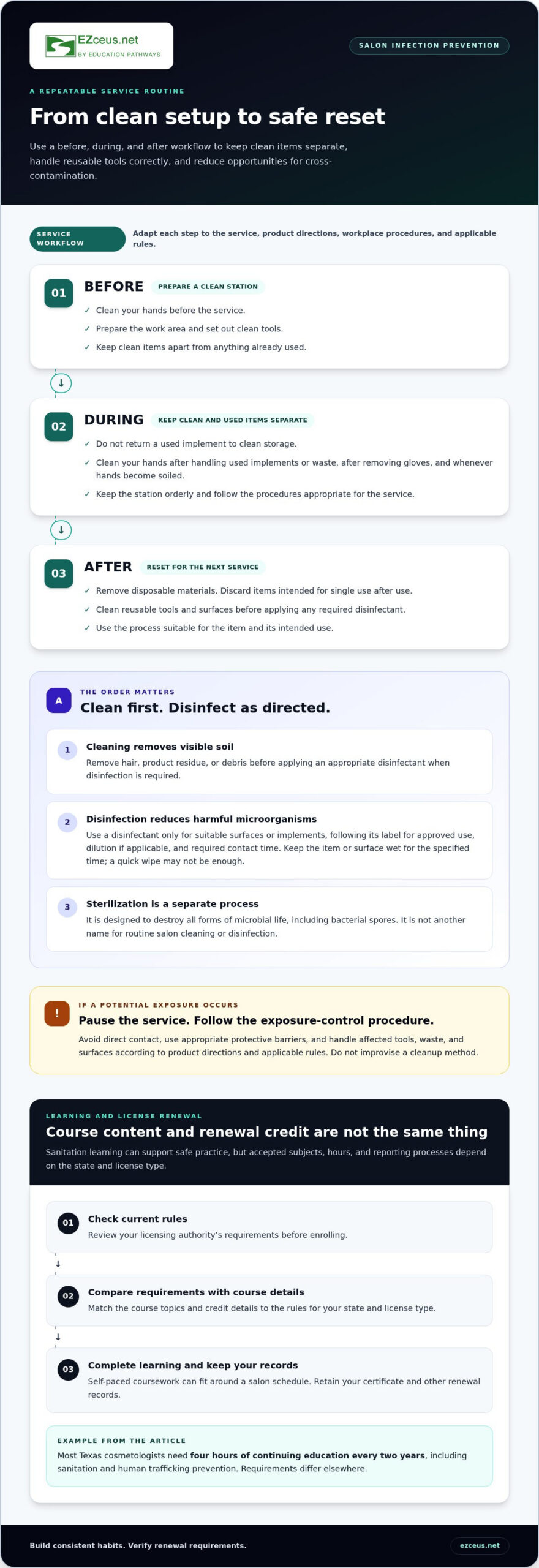
Sanitation is easier to manage when it follows the same sequence each time. Use this routine as a starting point, then adapt it to the service, workplace procedures, product directions, and rules that apply to your state and license. An online sanitation course for cosmetologists can reinforce the reasoning behind each step, making the routine more than a checklist.
A practical sanitation sequence before and after each service
Before the service: Prepare the station, clean your hands, and set out clean supplies. Keep them separate from used tools and anything that may be contaminated. Check that products and equipment are ready for the service.
During the service: Keep clean and used items apart. Clean your hands at appropriate points, such as after handling used implements or waste. If a tool becomes contaminated, follow your workplace procedure before using it again.
After the service: Discard single-use items as directed. Remove visible soil from reusable tools before following the appropriate disinfection steps. Clean the work surface, then use disinfectant according to its label, including the specified contact time. Reset the station with clean supplies only after the required steps are complete.
Repeating this order makes sanitation part of the service flow, even when appointments are close together. A consistent reset also makes it easier to spot a missed step.
What to do when a spill, exposure, or uncertainty occurs
Pause the service if blood, a spill, or another potential exposure creates a safety concern. Follow the salon’s established response procedure instead of improvising. Use the product label and workplace instructions to determine how to handle affected tools and surfaces. Never mix disinfectants or other chemicals unless the product directions specifically call for it.
If you’re unsure how to proceed, stop and refer to your workplace protocol and applicable state guidance before continuing. Record or report the incident as required by workplace policy and current rules. Clear steps help everyone respond consistently without relying on memory in a stressful moment.
For flexible learning alongside a working schedule, explore self-paced cosmetology continuing education.
Choosing a Relevant Online Sanitation Course and Completing It
A flexible course is useful only if it fits your renewal requirements. Before enrolling, match the course to your license and state, then review the current rules from the official licensing authority. This quick check helps distinguish useful sanitation learning from continuing education that counts toward renewal.
A simple checklist for matching course learning to your license
- Identify your license and renewal cycle. Check the exact license category and your state’s instructions.
- Compare requirements with the course. Review the subject, credit details, and approval status. Don’t assume a sanitation topic automatically meets a state’s CE requirement.
- Study and complete the course. Follow the course steps and finish any required assessments.
- Keep your records. Save the completion certificate and follow your state’s reporting process, if applicable.
Keep each check distinct. Course approval, accepted subjects, required hours, and reporting can be separate parts of renewal. EZceus provides state-specific online continuing education for cosmetologists and barbers in Florida, Iowa, Ohio, Texas, and Nebraska. Courses are officially state-approved in Florida, Ohio, and Texas. Review the details that apply to your license before counting a course toward renewal.
How self-paced continuing education supports busy cosmetologists
Salon schedules can leave little room for fixed class times. Self-paced study lets you work through course material around appointments and return to it as needed. For professionals seeking flexible online education, platforms like NAVO offer certified courses and structured learning resources designed to fit self-directed study schedules. That flexibility helps with planning, but it doesn’t replace checking that the course subject and approval status match your state’s instructions.
After completion, EZceus provides an instant digital certificate as a convenient record of your learning. Keep it with your renewal documents, and complete any separate state reporting steps required for your license.
Find a flexible option at online continuing education courses.
Make Your Next Renewal Step Clear
Strong sanitation habits come from consistent routines: prepare the station, handle tools carefully, and follow product directions and workplace procedures. A course can reinforce those practices, but it counts toward renewal only when its subject, approval, and format fit your state’s current requirements.
Before choosing an online sanitation course for cosmetologists, review the rules for your license and keep your completion records. That simple step connects useful learning with your renewal needs.
EZceus offers self-paced online continuing education for cosmetologists and barbers, with state-approved continuing education courses in Florida, Ohio, and Texas. Students receive an instant digital certificate upon course completion. Ready to find learning that fits your schedule? Explore self-paced cosmetology continuing education.
Carry practical sanitation knowledge into your salon routine and make your next renewal step clear.
Frequently Asked Questions
What does an online sanitation course for cosmetologists cover?
An online sanitation course for cosmetologists typically teaches practical infection-prevention habits, including hand hygiene, clean workspaces, safe tool handling, and proper disinfectant use. It may also explain how to manage reusable and single-use items and respond to potential exposure incidents. Course content varies. Apply what you learn alongside product directions, workplace procedures, and the sanitation rules that apply to your service and location.
Can cosmetologists take sanitation continuing education courses online?
Cosmetologists may be able to complete continuing education online, but whether online study counts toward renewal depends on current state rules and the license involved. Review your licensing authority’s instructions before enrolling. EZceus provides self-paced online continuing education for cosmetologists and barbers, with courses tailored to renewal requirements in Florida, Iowa, Ohio, Texas, and Nebraska. Match the specific course to your state’s requirements before counting it toward renewal.
Is an online sanitation course enough to renew a cosmetology license?
Not necessarily. A sanitation course may cover relevant material, but renewal can involve other requirements, such as a set number of continuing education hours, specific subjects, or a reporting step. Requirements differ by state and license type. Review your current renewal instructions to see whether sanitation education is required, how many hours count, and whether you need additional coursework or actions before your license can be renewed.
How do I know if an online cosmetology course meets my state requirements?
Compare the course’s subject, hours, approval status, and online format with your official licensing authority’s current instructions. Review the details for your state and license category, whether you’re renewing in Florida, Iowa, Ohio, Texas, or Nebraska. EZceus courses are officially state-approved in Florida, Ohio, and Texas. Don’t assume approval in one state applies elsewhere. Keep your completion record and follow any state reporting steps.
What is the difference between cleaning and disinfecting salon tools?
Cleaning removes visible soil, such as hair, product residue, or debris. Disinfecting reduces harmful microorganisms on suitable surfaces or implements when the product is used as directed. For reusable tools, cleaning generally comes before any applicable disinfection step. Follow the disinfectant label for its approved use and required contact time. These steps aren’t interchangeable, and the correct procedure depends on the tool, service, workplace practices, and applicable rules.
Do online cosmetology courses provide a certificate after completion?
Some online continuing education courses provide a completion certificate. EZceus students receive an instant digital certificate after completing their course. Keep the certificate with your renewal records, but don’t assume it replaces a separate state reporting requirement. Review your licensing authority’s instructions for what documentation to retain and how course completion must be reported. This is especially important if you hold licenses in more than one state.
How can cosmetologists fit continuing education into a busy schedule?
Self-paced online study lets cosmetologists plan coursework around salon appointments and other responsibilities, rather than attending at a fixed class time. Set aside manageable study periods and check your progress against your renewal deadline. EZceus offers self-paced continuing education for cosmetologists and barbers in Florida, Iowa, Ohio, Texas, and Nebraska. Choose a course that fits both your schedule and your state’s current renewal requirements.