
How to Reinstate an Expired Cosmetology License in Florida
If you’re wondering how to reinstate an expired cosmetology license in Florida, start by checking your official status with the Florida Department of Business and Professional Regulation (DBPR). The next steps depend on whether DBPR lists your license as delinquent or null and void.
Those statuses have different requirements. Confirm your record before applying, completing continuing education, or returning to practice. A standard renewal process may not apply to every expired license.
This guide walks you through checking your DBPR record, identifying the right reinstatement path, and organizing any education, application, and documentation steps. If continuing education is required, EZceus offers self-paced, online Florida courses that are state-approved and provide an instant digital certificate upon completion. A course alone does not reinstate a license, so follow the DBPR instructions for your specific status.
Key Takeaways
- Check your official Florida DBPR record and verify the displayed status before choosing a next step.
- To reinstate an expired cosmetology license in Florida, follow the DBPR instructions for your specific status, not a one-size-fits-all process.
- Active, delinquent, and null-and-void statuses point to different actions. Use the requirements that apply to the status on your record.
- Track continuing education, application submission, and the final license-status review as separate steps.
- If DBPR requires CE, a self-paced, state-approved Florida course can help you complete the education requirement and receive a digital certificate.
What an expired Florida cosmetology license means, and what it does not
An expired license generally means the renewal deadline passed without the renewal being completed. That differs from an active license approaching its renewal date. An active license may call for routine renewal steps, while an expired record may require a different Florida Department of Business and Professional Regulation (DBPR) process.
Cosmetology covers a range of professional services, as outlined in this general overview of Cosmetology. In Florida, though, your next step depends on the official status of your individual license, not on the broad meaning of the profession or how long ago you last worked.
How is an expired license different from a null-and-void license?
“Expired,” “delinquent,” and “null and void” are not interchangeable labels. Florida guidance distinguishes a delinquent license from one that has become null and void after it is not renewed for two consecutive licensure cycles. The distinction can affect which application, education, or other steps apply. Check your DBPR record and the current instructions instead of choosing a route based only on the date you remember.
These terms describe licensing status, not simply whether you consider your license current. If your record uses a label you don’t understand, review the DBPR guidance for that status before acting. One missed renewal and several missed cycles may not follow the same process.
Can you work while a Florida cosmetology license is expired?
Don’t assume an expired license authorizes you to practice. Before performing cosmetology services, verify your current license status and applicable practice permissions directly with Florida DBPR. If the public record and your paperwork appear inconsistent, resolve the discrepancy with the department before relying on either one.
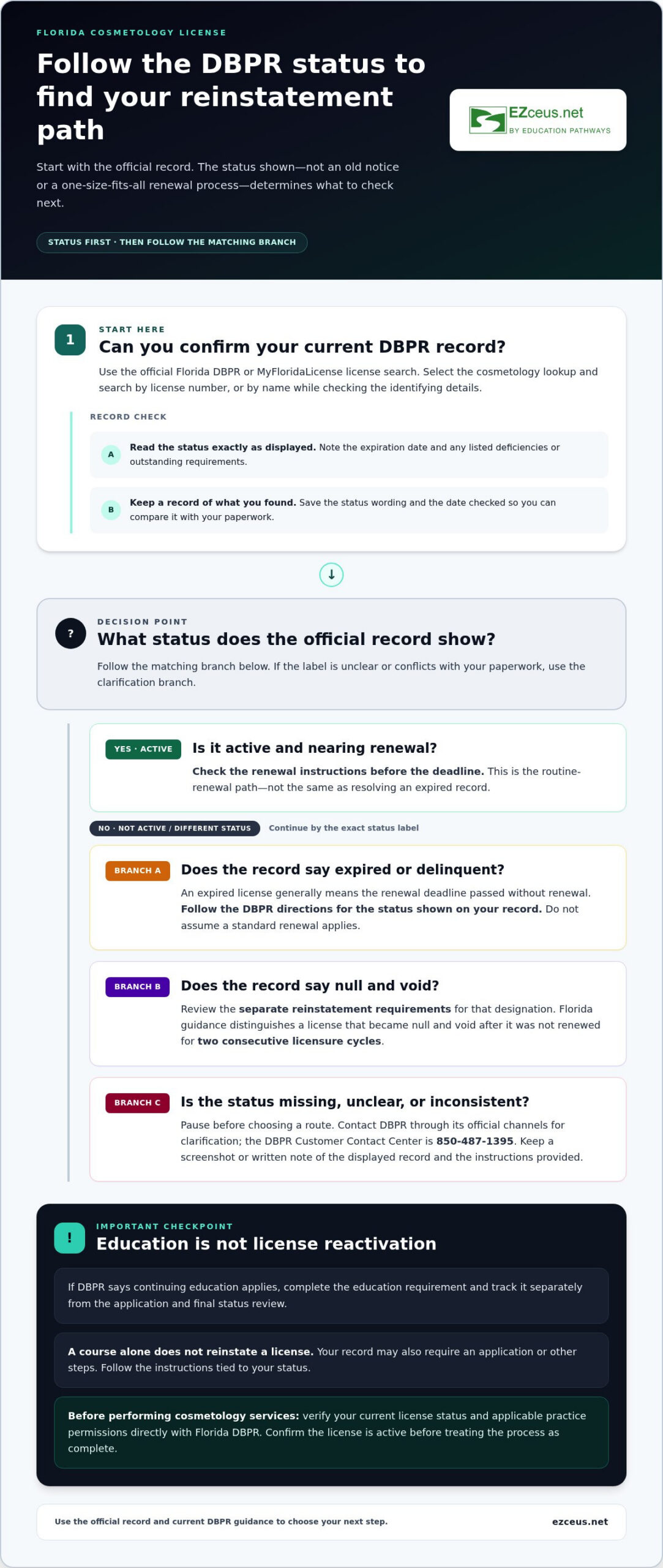
Continuing education does not, by itself, reactivate a license. A course may satisfy an education requirement when DBPR says it applies, but your record may also require an application or other steps. Follow the instructions tied to your status, then confirm the license is active before treating the process as complete.
If you’re researching how to reinstate an expired cosmetology license in Florida, start by verifying your status, not by enrolling in a course or assuming a standard renewal will fix the issue. Keep a copy of the status information and any DBPR instructions you receive. This helps you distinguish an expired record from a null-and-void one as you work through the process.
- Active and nearing renewal: Check the renewal instructions before the deadline.
- Expired or delinquent: Follow the DBPR directions for the status shown on your record.
- Null and void: Review the separate reinstatement requirements for that designation.
The status labels are a starting point, not the final answer. Use the official record and current DBPR guidance to decide what to do next.
How to check your Florida cosmetology license status with DBPR
Use the Florida Department of Business and Professional Regulation (DBPR) and its MyFloridaLicense resources to check your cosmetology license. A third-party summary may not show the current status or the details tied to your record. Start with the official Florida Board of Cosmetology page and its license lookup or online services.
Follow these steps to confirm you have the right record before choosing a next step:
- Open the official DBPR or MyFloridaLicense license search and select the cosmetology license lookup.
- Search by license number if you have it. If you search by name, compare the identifying details so you don’t rely on someone else’s record.
- Read the status exactly as displayed. Note the expiration date and any listed deficiencies or outstanding requirements.
Keep the status wording as it appears. “Active,” “delinquent,” and “null and void” can lead to different DBPR instructions. Don’t interpret an unfamiliar label based on memory or an old renewal notice. Use the official record as your starting point.
What information should you gather before checking your record?
Have your cosmetology license number and identifying details, such as the name associated with the license, ready. Once you find the record, write down the status wording, expiration date, and each listed deficiency or requirement. These notes help you follow up accurately and compare the record with any correspondence you have.
Protect your personal information when using online licensing services. Use official DBPR pages, avoid entering identifying details on third-party lookup sites, and don’t share account credentials. Save only the information you need, such as a screenshot of the status and the date you checked.
What should you do if the DBPR record is unclear?
If the status is missing, conflicts with your paperwork, or includes a requirement you can’t interpret, contact DBPR through its official channels for clarification. The DBPR Customer Contact Center can be reached at 850-487-1395. Keep a screenshot or written record of what the site displayed, the date you checked, and any instructions the department provides.
Don’t choose a reinstatement route based only on an old renewal notice. It may not reflect your current record. Confirm the status and ask DBPR to clarify any uncertainty before submitting an application or relying on a course to meet a requirement. If you’re reviewing routine renewal timing rather than resolving an expired status, the Florida cosmetology license renewal guide provides that context.
Once DBPR’s instructions show that continuing education applies, you can use self-paced Florida CE courses to complete that education step. Checking your record first keeps course completion separate from an application or final status update, and helps you understand how to reinstate an expired cosmetology license in Florida based on your actual record.
Choose the right reinstatement path for your Florida license status
Your DBPR record determines which route to follow. Don’t treat routine renewal instructions as guidance for every expired license. Use the comparison below to identify what to review next, then confirm current requirements with DBPR before paying a fee, completing a course, or submitting an application.
Active, nearing renewal: Follow the current renewal instructions attached to your record. Confirm the deadline and any renewal requirements directly with DBPR.
Expired or delinquent: Open the instructions for the status shown on your record. Check whether renewal, continuing education, fees, or other steps apply to your specific license.
Null and void: Review the separate reinstatement pathway and current eligibility conditions. Don’t assume routine renewal or payment alone will restore the license.
Requirements can change, so verify any 2026 deadline, course requirement, fee, form, or eligibility rule against current DBPR guidance. Let your record and its instructions guide the next step, rather than relying on a general account of how another license was renewed.
If the record shows an expired or delinquent license
Follow the renewal or reinstatement instructions attached to your DBPR record. Continuing education may be required, but confirm the required hours and course subjects before enrolling. Routine renewal guidance may not cover every expired-license situation. If the record lists a deficiency, address it according to DBPR’s directions and retain proof of completion or payment as applicable.
Keep the process in order: confirm your status, identify each requirement, complete applicable education, then submit the requested materials. Completing CE alone does not confirm that DBPR has renewed or reinstated your license. Check the record again for the final status.
If the record shows a null-and-void license
Treat null and void as a separate application route. Current DBPR materials identify Form COSMO 7, the DBPR COSMO 7 Null and Void Application, for this status. The form and related instructions may set out eligibility, documentation, education, and fee requirements. Verify the current form version and all conditions with DBPR before applying.
Use DBPR’s current guidance to determine whether you need to explain why the license wasn’t renewed, complete a specific course, or meet another condition. Reinstatement isn’t automatic, so don’t assume the ordinary renewal payment will resolve a null-and-void status. Check whether an examination applies to your circumstances rather than relying on an assumption.
When figuring out how to reinstate an expired cosmetology license in Florida, the key decision is the status DBPR actually displays. Confirm it first, then follow the matching official instructions. This helps you avoid completing the wrong course or application and keeps each requirement tied to the route that applies to your license.
Complete the required steps and document your reinstatement request
Once you know which DBPR process applies, work through its instructions in order. Treat course completion, application submission, and the final status update as separate milestones. Finishing one does not automatically complete the others.
Use this checklist to keep your reinstatement request organized:
- Confirm your status. Save the current DBPR record and note the status wording, expiration date, and any deficiencies.
- Follow the matching instructions. Use the requirements attached to your license status, including the current forms and submission method.
- Complete applicable requirements. Verify whether your route requires continuing education, supporting documents, or other steps before proceeding.
- Submit all required materials. Keep confirmation details and proof of any payment or document submission.
- Review the final status. Check your official DBPR record after submission. Don’t assume the license is active just because you completed a course or sent an application.
Required documents and processing times can vary by process and according to current DBPR instructions. Review the official guidance for your license status before submitting anything, and use DBPR’s current timelines rather than an estimate from an older notice or an unrelated renewal experience.
How to handle continuing education and supporting records
First confirm whether CE applies to your status and which course requirements DBPR specifies. After completing an applicable course, save the certificate and completion confirmation somewhere easy to find. EZceus provides an instant digital certificate after course completion, giving you a record of that education step. The certificate doesn’t replace a separate application or any other DBPR requirement.
Keep your records together. Include copies of the instructions you followed, completed forms, supporting documents, course records, payment receipts, and messages from DBPR. Use clear filenames and dates to identify what you submitted and when. Retain the original digital files, even if you also print copies.
How to follow up after submitting your materials
After submitting your materials, monitor your official account and the contact method you used with DBPR. Save any confirmation number or reference, and respond promptly if the department requests more information. Keep dated copies of your application and attachments. If the record doesn’t change or you’re unsure what a request means, use DBPR’s official contact channels for guidance.
Before resuming regulated cosmetology services, verify that your official record shows active status and review any applicable practice instructions. Course completion is not the same as an active license, and an application receipt alone doesn’t mean the process is finished.
If DBPR confirms that Florida CE is required for your path, complete your applicable Florida CE online with self-paced, state-approved courses and keep the digital certificate with your reinstatement records.
Use Florida-approved online CE when DBPR requires it
Continuing education may be part of reinstatement, but it does not replace the rest of the process. Before choosing a course, check the current DBPR instructions for your license status. Confirm whether CE applies and which course subjects and hours are required. Routine renewal requirements may differ from those for a license that has expired or become null and void.
If DBPR directs you to complete Florida cosmetology CE, EZceus offers self-paced, online courses that are state-approved. Complete the applicable education on your schedule, then receive an instant digital certificate. Keep that certificate with your licensing records. It documents the education step, but it doesn’t prove your application is complete or reactivate your license.
How to fit a self-paced CE course into your next steps
Compare your DBPR instructions with the course requirement you need to meet. Confirm the required hours and subjects before beginning, especially if your status calls for a specific type of education. Self-paced access lets working cosmetologists complete applicable learning around their schedules. Save the certificate and completion confirmation with your application materials so they’re easy to locate if needed.
Use this simple recordkeeping checklist:
- Keep a copy of the DBPR instructions showing the applicable CE requirement.
- Save the course completion confirmation and digital certificate.
- Store these records with your forms, supporting documents, and submission confirmations.
What to do once the course is complete
Follow the course completion instructions and download or save your instant digital certificate. Then continue with the remaining DBPR steps for your license status. Those steps may include submitting an application or other required materials. Education is only one part of the process; don’t treat the certificate as proof that your license has returned to active status.
After submitting the required materials, monitor your official DBPR account and follow any instructions or requests from the department. Check the license record for active status before returning to regulated cosmetology services. If the record hasn’t updated or the next step is unclear, contact DBPR through its official channels for guidance.
EZceus also offers online continuing education for cosmetologists and barbers renewing licenses in Texas, Ohio, Iowa, and Nebraska. Florida, Texas, and Ohio courses are state-approved. For Florida, if your DBPR instructions require CE, explore Florida cosmetology CE courses to complete the applicable education step online at your own pace. Keep your certificate with your reinstatement records and continue following DBPR’s status-specific directions. CE can help satisfy an education requirement, but only the state licensing process determines whether your license is active again.
Take the next step with confidence
Make your next move based on the instructions tied to your official license record. If DBPR requires continuing education, complete that requirement and keep the documentation with your application materials. Follow through on any remaining steps and confirm your license status before returning to practice. A clear record of what you’ve completed can help you respond to questions or requests from the department.
If CE is part of your path, EZceus offers self-paced, online Florida courses that are state-approved, with an instant digital certificate after completion. The course can support the education step, while DBPR determines the status of your license. For how to reinstate an expired cosmetology license in Florida, keep those two parts distinct and follow the official process through the final status check.
Explore self-paced Florida cosmetology CE courses if DBPR’s instructions call for continuing education. Complete the course at your own pace and keep the certificate with your reinstatement records.
Frequently Asked Questions
Can I reinstate an expired cosmetology license in Florida online?
Some license actions may be available through DBPR’s online services, but the route depends on the status shown in your record. Start with MyFloridaLicense and follow the instructions for your specific license. A null-and-void application may require a different submission process from a delinquent renewal. Before submitting online, confirm that the instructions match your status and that you have the required forms and supporting documents.
How long can a cosmetology license be expired in Florida before it becomes null and void?
A Florida cosmetology license becomes null and void if it isn’t renewed for two consecutive licensure cycles. Don’t estimate the period in months, since the status depends on the renewal cycles. Check your DBPR record for the exact designation. If the record doesn’t clearly show how your license is classified, ask DBPR before choosing a reinstatement route.
Do I need continuing education to reinstate an expired Florida cosmetology license?
It depends on your license status and the DBPR instructions that apply. The requirements described here specify 10 hours of CE for reinstating a delinquent license. A null-and-void application has a separate education condition: a four-hour initial HIV/AIDS course completed within the two years before applying. Confirm the exact requirements for your record with DBPR before choosing or completing a course.
Can I work as a cosmetologist in Florida while my license is expired?
Don’t assume you can practice while your license is expired. Check the official DBPR record and confirm your practice permissions with the department before performing regulated cosmetology services. If you’ve submitted renewal or reinstatement materials, wait for the official status to show active rather than treating a payment receipt, course certificate, or application confirmation as approval to work.
What is the difference between an expired and a null-and-void Florida cosmetology license?
“Expired” is a general description meaning the renewal date has passed. DBPR may display a more specific status, such as delinquent or null and void, and those labels can lead to different instructions. A null-and-void status applies after two consecutive licensure cycles without renewal. Use the exact status on your regulator record, not your own description of how long the license has lapsed.
Does completing an online cosmetology CE course automatically reactivate my Florida license?
No. Completing a course can document an education requirement if DBPR requires it, but it doesn’t complete a separate application or change your license status by itself. Save your course certificate and follow the remaining instructions for your record. Then check the official DBPR license lookup for active status. An instant digital certificate is proof of course completion, not confirmation that your license is reinstated.
What should I do if my Florida license record shows the wrong status?
Contact Florida DBPR through its official channels and ask for clarification before submitting an application based on the disputed status. Have your license number and relevant renewal records available. Save a dated screenshot of the listing and keep notes of the department’s instructions. The DBPR Customer Contact Center can be reached at 850-487-1395. Check your official record again after any correction or update.